AI Research Skills by WenyuChiou
 by WenyuChiou
Universal SKILL.md catalog for research workflows: literature review, research design, project memory, manuscript writing, and cross-agent delegation for Claude Code, Codex, Gemini, Cursor, OpenClaw, and generic AI clients.
AI Research Skills is an open-source agent skill by WenyuChiou, written mainly in Python, with 526 GitHub stars and the MIT license. Its code was last updated Oct 30, 2026. The latest PyPI release is research-hub-pipeline 1.2.0, published Aug 31, 2026, with 188 downloads last week.
AI Research Skills
The catalog, installation, and visual layer for a Vertical AI Research Reference Harness. Move from research orientation to release through 17 portable skills, an eight-stage lifecycle, evidence-aware handoffs, and explicit human gates.
Built for graduate students, PhDs, postdocs, research support staff, and
agent/harness builders who need inspectable research workflows rather than a black box.
The portable skills live in this repository; research-hub supplies the executable
runtime, while the optional agent-collab-harness adds policy/checkpoint governance.
Languages: English | 繁中 · Pipeline · Examples · Runtime contract · Glossary · For Agent/Harness Builders
<sub><a href="LICENSE"><img alt="License: MIT" src="https://img.shields.io/badge/license-MIT-blue"></a></sub>
📚 Part of the agentic AI learning roadmap — featured in §13–14 (research workflows).
Start here — Why, what, and how
See the whole research lifecycle first
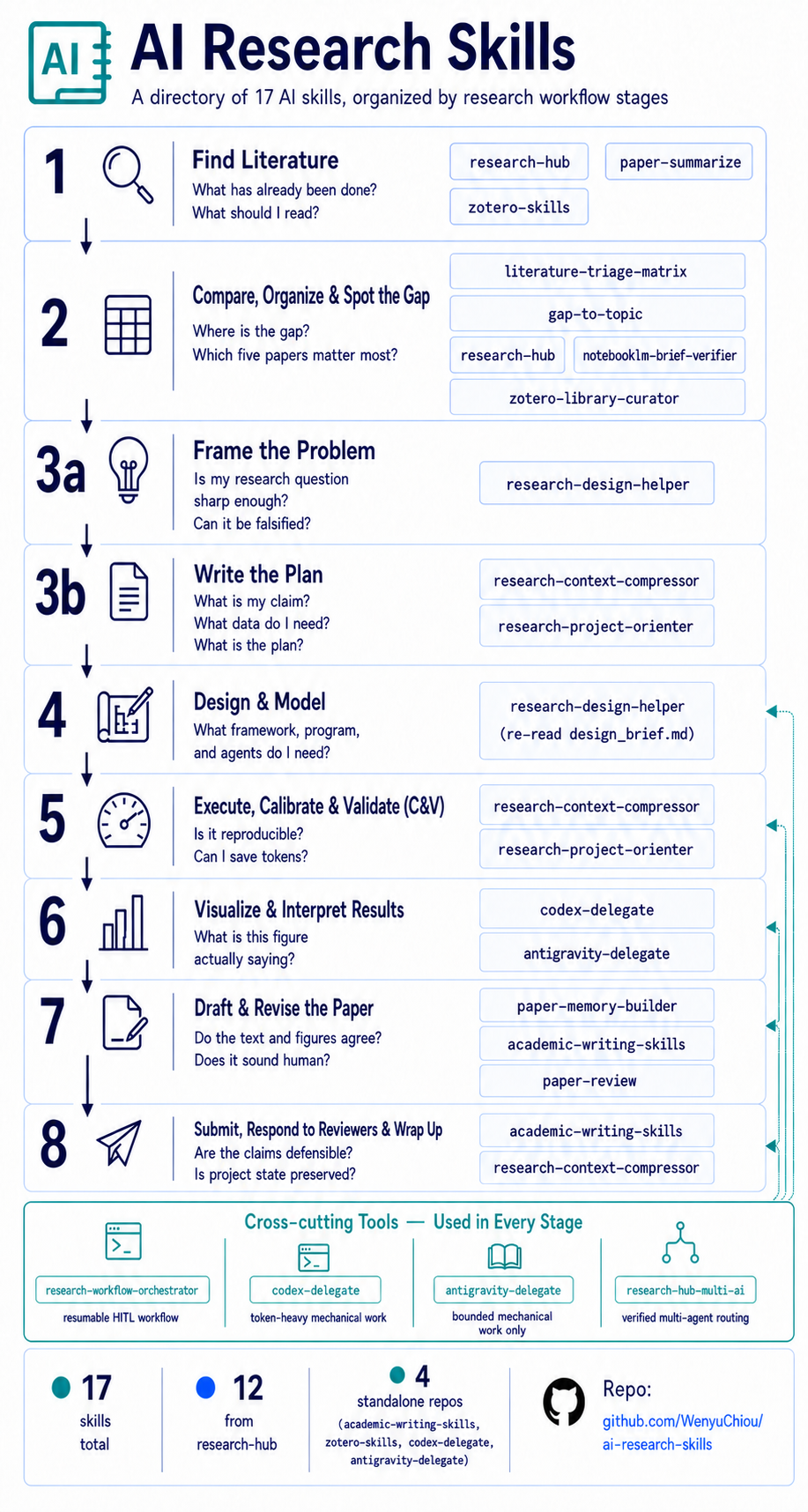
<sub>The 17-skill core is organized around durable handoffs: each stage produces the next stage's input, while cross-cutting tools preserve context, verification, and delegation boundaries.</sub>
| Your first question | Short answer | Go deeper |
|---|---|---|
| Why use these skills? | Keep research context durable, verify evidence before claims move downstream, and pause automation at meaningful human decisions. | Problems this catalog solves |
| What is included? | 17 portable skills, 8 lifecycle stages, 5 installable plugins, an executable research runtime, and an optional policy/checkpoint harness. | Skill outputs |
| How do I use it? | Install the 12-skill research workspace, then ask for a concrete research outcome in natural language. Add writing, Zotero, or delegation plugins only when needed. | 30-second install · Usage patterns |
| 17 core skills | 8 research stages | 5 optional-by-need plugins | 3 truth-store integrations |
|---|---|---|---|
Portable SKILL.md contracts | Orientation → release | Start with 1; grow to 5 | Zotero · Obsidian · NotebookLM |
Try the smallest useful path
claude plugin marketplace add WenyuChiou/ai-research-skills
claude plugin install research-workspace@ai-research-skills
Then ask, for example:
Build a literature triage matrix for human-in-the-loop research agents. Verify identifiers, preserve contradictions, and show me the evidence gaps before recommending next steps.
Need an executable, resumable workflow instead of prompt-only skills? Continue
with pip install research-hub-pipeline, then run research-hub setup and
research-hub doctor. The full path is in Install.
Understand the two control layers
Harness architecture — deterministic control around semantic work
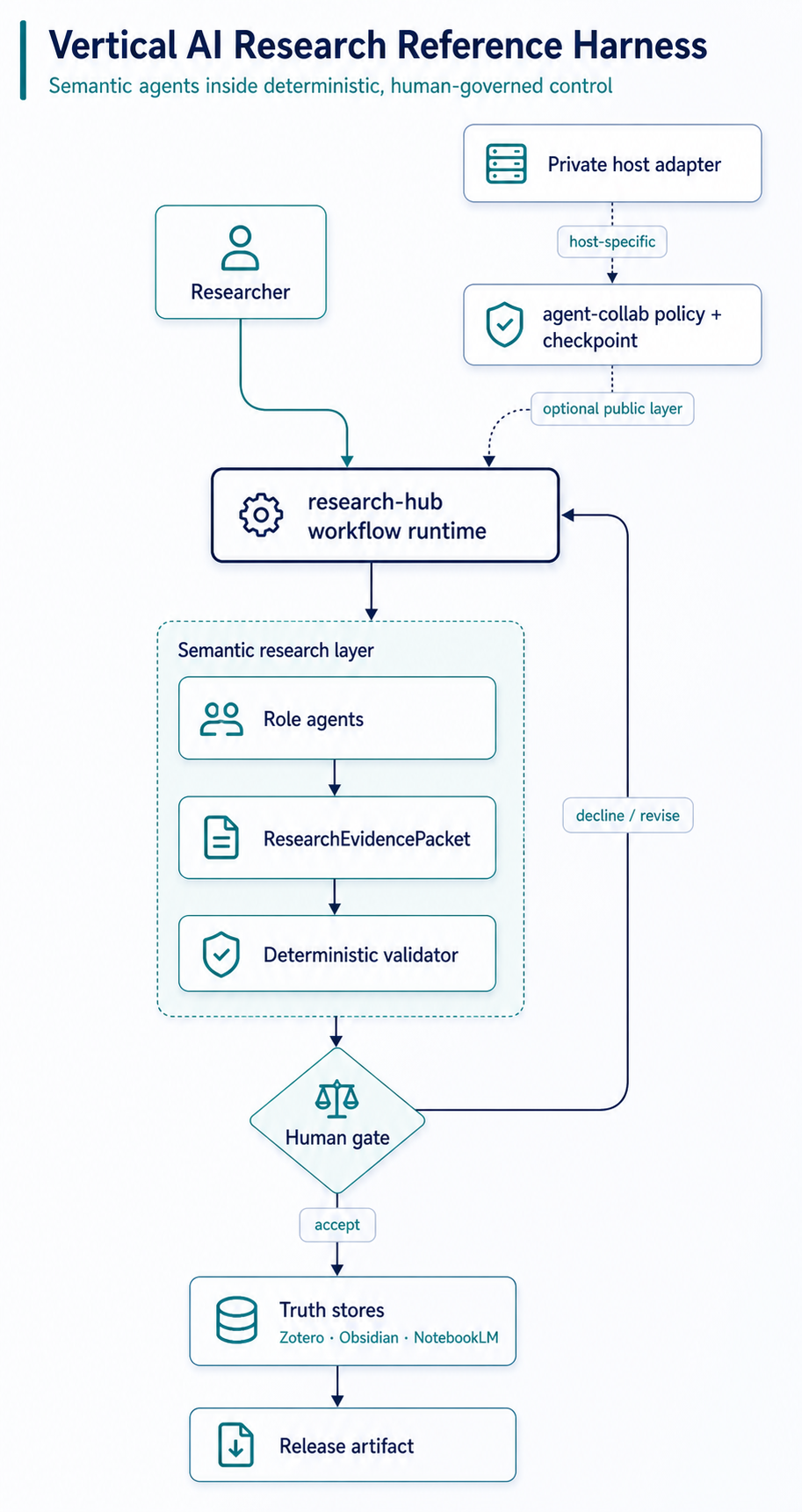
<sub>research-hub owns the research-domain runtime and recoverable state. Role agents do semantic work; deterministic validators, evidence contracts, and the optional agent-collab-harness policy/checkpoint layer control what may proceed.</sub>
Human-in-the-loop — where automation must pause
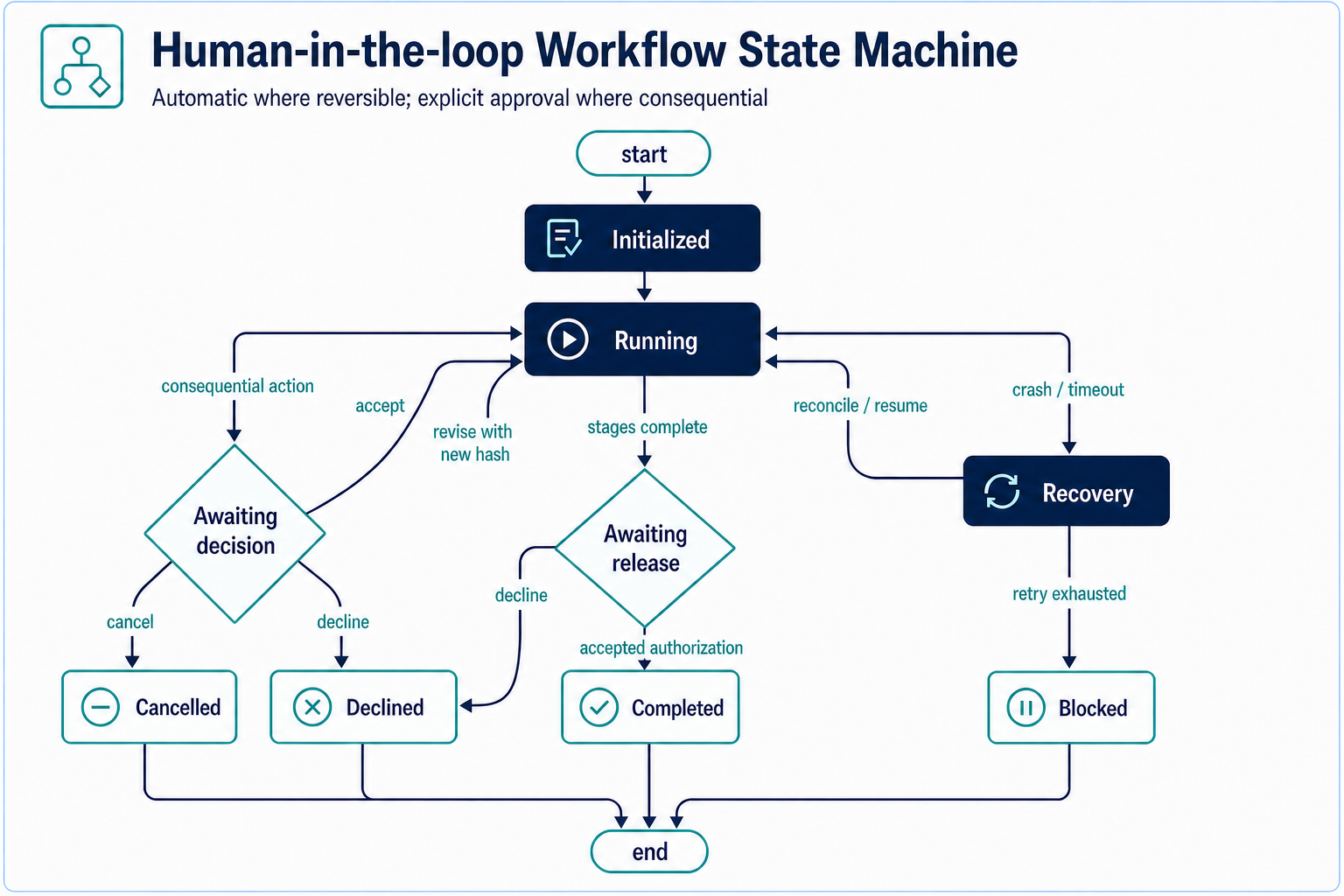
<sub>Read-only and reversible steps can continue automatically. Breaking contracts, skill removal, external writes, semantic acceptance, and release authorization remain explicit human decisions.</sub>
| If you are… | Best next page |
|---|---|
| A researcher or research team | Follow the eight-stage pipeline after the quick install above. |
| An agent or harness builder | Read the architecture, state, HITL, recovery, and evaluation guide. |
| Evaluating portability or trust boundaries | Review compatibility, the runtime contract, and limitations. |
Contents
- Install — get the skills
- Why this catalog exists
- The pipeline — what each stage delivers to the next
- Use it
- See what each skill produces
- FAQ
- Compatibility
- Limitations
1. Install — get the skills
The core asset is portable SKILL.md; Claude Code marketplace support is
the convenience layer. Use the path that matches your host:
| Host | Path |
|---|---|
| Claude Code | Marketplace install below; gets auto-triggering and claude plugin list verification. |
| Codex CLI / Cursor / Windsurf | Load the canonical repo's SKILL.md into the host's skills/rules directory, or inline it into the prompt. |
| Gemini CLI / generic API client | Inline SKILL.md as prompt or system context. |
| Hermes | Install a raw SKILL.md; this repo has Hermes 0.13.0 skill-load verification for literature-triage-matrix. |
| OpenClaw | Use a SKILL.md directory shape such as ~/.openclaw/skills/<skill>/SKILL.md when supported; not release-verified here yet. |
Full per-host recipes are in docs/install.md → Using these skills outside Claude Code.
Claude Code fastest path — 30 seconds:
claude plugin marketplace add WenyuChiou/ai-research-skills
claude plugin install research-workspace@ai-research-skills
Windows cmd.exe: run the commands one at a time. If the plugin list
does not show research-workspace@ai-research-skills, your paste probably
only executed the first line; see docs/install.md for the
single-line CMD form.
For Claude Code, the first two commands install the 12-skill
research-workspace plugin. Add the optional plugins only when you need
manuscript writing, full Zotero operations, or Claude-to-Codex/Antigravity
delegation.
Additive install — stop after any step and use what you have:
# 1. Marketplace + 12 research-hub skills
claude plugin marketplace add WenyuChiou/ai-research-skills
claude plugin install research-workspace@ai-research-skills

# 2. Manuscript work — outline, drafting, prose and evidence audit, scientific review (14/17)
claude plugin install academic-writing-skills@ai-research-skills

# 3. Zotero CRUD (15/17; enable local API in Zotero desktop first — docs/setup-guide.md §C)
claude plugin install zotero-skills@ai-research-skills

# 4. Multi-CLI delegation (17/17; install codex / agy CLI binaries first)
claude plugin install codex-delegate@ai-research-skills
claude plugin install antigravity-delegate@ai-research-skills

# 5. Literature pipeline automation (Python CLI behind research-hub skills)
pip install research-hub-pipeline
research-hub setup --persona researcher
research-hub doctor
Separate live smoke (not installation):
This is a live literature workflow, not an offline install check.
--no-nlm disables NotebookLM only; it does not disable other network calls,
models, or writes. Complete the live-run preflight
and obtain the applicable data/cost/write authorization before running:
research-hub auto "agent-based modeling" --max-papers 3 --no-nlm
Batch all 5 plugins in one go:
bash scripts/install-all.sh        # macOS / Linux / git-bash
pwsh scripts/install-all.ps1       # Windows PowerShell
Verify:
claude plugin list
# fastest path: research-workspace@ai-research-skills is ✔ enabled.
# full install: 5 plugins ending in @ai-research-skills are ✔ enabled.
claude plugin list verifies only the Claude Code marketplace install.
It does not tell you whether Codex, Cursor, OpenClaw, Hermes, or a
generic API client has loaded the SKILL.md files. Marketplace-installed
plugins live under ~/.claude/plugins/cache/..., not ~/.claude/skills/.
Per-plugin details: docs/install.md. Python / Zotero / Git not set up yet? Start with docs/setup-guide.md. Need to know whether a skill is prompt-only or needs the Python runtime? See docs/runtime-contract.md.
<details> <summary><b>I'd rather clone the repo</b> (contributors / debugging)</summary>git clone https://github.com/WenyuChiou/ai-research-skills.git
cd ai-research-skills
This catalog is the registry, not a monorepo. Each plugin's source code lives in its own repo:
github.com/WenyuChiou/research-hub— 12research-workspaceskillsgithub.com/WenyuChiou/academic-writing-skills— 2 skillsgithub.com/WenyuChiou/zotero-skills— 1 skillgithub.com/WenyuChiou/codex-delegate— 1 skillgithub.com/WenyuChiou/antigravity-delegate— 1 skill
If you're hacking on a plugin, clone its source repo, not this
catalog. This catalog only maintains marketplace.json, docs, image
assets, and the catalog-side CHANGELOG.md.
2. Why this catalog exists
You probably know the AI-for-research pain points already. The five below are the ones this catalog actually fixes — not the ones it gestures at.
P1 — "I keep re-explaining context to every new AI session"
You open a new Claude / ChatGPT session to continue yesterday's work, and the model knows nothing about your research question, the experiments you've already finished, your baselines, or the gap you closed last week. You spend the first ten minutes re-typing all of it. Tomorrow, again.
P2 — "AI confidently cites papers that don't exist"
The model writes "as Chen et al. (2024) demonstrated…" — the paper is not real. You catch it (this time). In a reviewer response, a hallucinated citation is a desk-reject.
P3 — "I've read 50 papers and still can't tell which gap is worth a thesis"
Three questions need structured answers: (1) is the gap actually still open? (2) is closing it a real contribution or a permutation of existing work? (3) can I close it in the time I have? Tools that produce a one-paragraph "research gap summary" don't answer any of them.
P4 — "AI-written prose smells like AI"
"Furthermore", "It is noteworthy that", hedged sentences with no committed claim. Reviewers (and senior co-authors) catch the smell in two paragraphs, and the manuscript drops in their priority list.
P5 — "Switching Claude / Codex / Antigravity wipes my state"
You design the prompt with Claude, hand it to Codex to scaffold the code, then use Antigravity only for bounded mechanical follow-up work. Long-context synthesis, CJK drafting, judgment, governance, and final review stay with the primary model. Each switch still costs five minutes of re-onboarding unless the handoff is explicit and durable.
Three design principles, applied across 17 skills
The catalog is arranged around three load-bearing ideas, not a feature list:
| Principle | What it does | Solves |
|---|---|---|
1. Manifests (.research/, .paper/) | Research state lives in checked-in YAML / Markdown files. A new AI session reads the manifest and re-onboards itself — you don't re-explain context. | P1, P5 |
| 2. Schemas with anti-leakage rules | Every cross-skill artifact has a YAML schema. A claim with empty evidence_artifacts is forced to carry status: gap + a gap_reason — never supported. A topic candidate with verdict: do-not-pursue is structurally separated from worth-pursuing ones. Downstream tools refuse to ship overconfident output. | P2, P3, P4 |
| 3. Character-driven routing | Token-heavy mechanical bulk → Codex. Bounded non-honesty-critical mechanical work → Antigravity. Long-context, CJK, judgment, governance, and final review stay with the primary model. The router (research-hub-multi-ai) writes a coordination file so each delegate reads its own brief, not the parent context. | P5 |
The eight-stage visual map above shows these three principles applied to a real research workflow.
3. The pipeline — what each stage delivers to the next
Eight stages from "I should read about X" to "the manuscript shipped". Each stage's output is the next stage's input — the handoff is mechanical, not vibes.
Use research-workflow-orchestrator when the whole lifecycle needs one
stateful controller: it coordinates orient, scope, discover, synthesize,
design, execute, write, and release; proceeds automatically for
read-only or reversible work; and pauses at the five human gates.
| # | Stage | Skill(s) | Output → next stage |
|---|---|---|---|
| 1 | Discover literature | research-hub, paper-summarize | .bib + per-paper Key Findings notes → Stage 2 |
| 2 | Find the gap | gap-to-topic, literature-triage-matrix, notebooklm-brief-verifier, zotero-library-curator | topic_dossier.gaps.yml (with verdict, verdict_reason) → Stage 3a |
| 3a | Frame the RQ | research-design-helper | design_brief.md (frontmatter source: gaps.yml#G2, gap_verdict) → Stage 3b + Stage 4 |
| 3b | Plan the project | research-context-compressor, research-project-orienter | project_manifest.yml (provenance.from_gap) → Stages 4–8 |
| 4 | Build the model | cookbook — codex-delegate for ≥5-file scaffold, Claude direct for ≤4-file or judgment work | code in your project repo (see cookbook) → Stage 5 |
| 5 | Run & validate | research-context-compressor, research-project-orienter | .research/ run manifests so future AI sessions skip the rescan → Stage 6 |
| 6 | Visualise & interpret | codex-delegate, antigravity-delegate, primary model | figures + analysis scripts → Stage 7 |
| 7 | Draft the manuscript | paper-memory-builder, academic-writing-skills | .paper/claims.yml (with status enum + anti-leakage) → Stage 8 |
| 8 | Submit + respond | academic-writing-skills, research-context-compressor | reviewer-response.md, version-tagged manifests → done |
The cross-skill handoffs (Stage 2 → 3a → 3b → 8; Stage 7 → 8) are
documented as YAML schemas, not free text. A downstream skill can
refuse to process a malformed handoff — and does, when the schema
violation would otherwise propagate (e.g. status: gap claims with no
gap_reason are rejected at Stage 7).
Cross-cutting (every stage): research-workflow-orchestrator,
codex-delegate, antigravity-delegate, research-hub-multi-ai.
These sit beside the pipeline, not on it — the orchestrator preserves
lifecycle state and gates, while multi-agent routing uses Codex and
Antigravity leaves for bounded mechanical execution.
Full narrative + per-stage tool tables: docs/pipeline.md.
4. Use it
Pick by goal
If you'd rather not read the full pipeline above, jump in by your immediate goal:
| Your immediate goal | Skills you'll use |
|---|---|
| Find & compare literature | research-hub + literature-triage-matrix |
| Write or revise a paper | paper-memory-builder + academic-writing-skills |
| Manage a research project | research-design-helper + research-context-compressor + zotero-library-curator |
For literature discovery, start with the search and source-reading capabilities actually available in Codex or Claude Code. Zotero, Obsidian and NotebookLM are optional, not a required setup detour; follow the existing Stage 1 evidence handoff.
Helping others adopt AI for research (librarian / RA / advisor)? No install needed — share this README plus docs/install.md.
Or, just describe what you want
Describe what you want in plain language — Claude Code matches your phrasing to a skill. You don't need to remember skill names.
| When you say… | Skill that activates |
|---|---|
| "Compare these 5 papers by method, data, limitations" | literature-triage-matrix |
| "Is this gap worth a thesis? Walk me through the three gates" | gap-to-topic |
| "Walk me through my research design before I start coding" | research-design-helper |
| "Check this paragraph's terminology, repeated wording, flow, and overclaim" | academic-writing-skills |
| "Review this paper and load the relevant notation, display, SEM, LLM, water, or flood checks" | paper-review |
Full trigger map (17 rows): docs/skill-directory.md.
If auto-trigger picks the wrong skill, name it explicitly:
"Use literature-triage-matrix to compare these 5 papers."
Already use Zotero / Obsidian / NotebookLM?
Have any of Zotero / Obsidian / NotebookLM in your workflow?
research-hubintegrates whichever of these you have as one library-management loop: search new literature (arXiv, Semantic Scholar) → Zotero metadata + ingest → per-paper notes synced to Obsidian → NotebookLM briefs verified against source bundles. All three tools are optional —research-hubadapts to whichever subset you have (or even none, in sample-dashboard mode). Python-CLI-backed;pip install research-hub-pipeline.Already run independent MCP servers for these tools (e.g.
paper-search-mcp, a Zotero MCP, a NotebookLM MCP)? They coexist — the skill orchestrates workflows, the MCPs give raw tool access. The CLI itself also exposes an MCP interface (research-hub serve). Full setup + tool-by-tool modes: research-hub project README.
All 17 skills
<details> <summary><b>From <a href="https://github.com/WenyuChiou/research-hub"><code>research-hub</code></a> (12 skills)</b> — one install gets all</summary>research-hub— search, ingest, organise papers across Zotero / Obsidian / NotebookLM. (Stages 1, 2)literature-triage-matrix— comparison matrix across method, data, claim, limitation. (Stage 2)notebooklm-brief-verifier— verify NotebookLM briefs against source bundles. (Stage 2)zotero-library-curator— audit Zotero, propose cleanup (preview-only withoutzotero-skills). (Stage 2)gap-to-topic— 3-gate go/no-go decision dossier for a candidate thesis/proposal topic (open? a contribution? feasible?). Emits.gaps.ymlforresearch-design-helperStage 3a handoff. (Stage 2)research-design-helper— Socratic dialog through RQ → mechanism → identifiability → validation → risk. Reads.gaps.ymlto pre-fill segments 1 + 5; Stage 4 cookbook reuses the produceddesign_brief.md. (Stages 3a, 4)research-context-compressor—.research/manifests so future AI sessions skip the rescan. (Stages 3b, 5, 8)research-project-orienter— fast orientation memo from those manifests. (Stages 3b, 5)research-hub-multi-ai— character-driven routing across the primary model, Codex, and Antigravity. (Cross-cutting)research-workflow-orchestrator— resumable controller for orient → scope → discover → synthesize → design → execute → write → release, automatic for read-only/reversible work and paused at catalog human gates. (All stages)paper-memory-builder—.paper/claims.yml+.paper/figures.yml(status enum, anti-leakage rule, file sentinels). (Stage 7)paper-summarize— fill per-paper Key Findings / Methodology / Relevance in both Obsidian and Zotero child notes afterresearch-hub auto. (Stage 1)
academic-writing-skills— extended outlines, scoped pre-draft plans and post-edit checks, chapter closure, shared terminology records, four-pass manuscript review, cross-artifact revision, and release readiness. (Stages 7, 8)paper-review— general scientific review with progressively selected equation/display provenance, psychometrics/SEM, AI/LLM, water/CNHS, flood/hydrodynamics, round, and explicit reviewer modules. (Stages 7, 8)zotero-skills— full Zotero CRUD, batch metadata, library maintenance. (Stages 1, 2, 7)codex-delegate— Claude → Codex CLI handoff for code-heavy / mechanical work. (Cross-cutting, also Stages 4, 6)antigravity-delegate— Claude → Antigravity CLI handoff for bounded non-honesty-critical mechanical work. (Cross-cutting, also Stages 4, 6)
Time + cost expectations
Rough envelope from in-session use — adjust to your input size:
| Task | Typical wall time | Conversation turns | Notes |
|---|---|---|---|
Compare 5 papers (literature-triage-matrix) | 1–3 min | 1–2 | Linear in paper count; 20 papers ≈ 5 min |
3-gate gap decision (gap-to-topic) | 5–15 min | 3–6 | Scales with candidate count + literature-recall depth |
Terminology, repetition, and flow audit on 1 paragraph (academic-writing-skills) | <1 min | 1 | Independent of manuscript size |
Reviewer response (6 comments) (academic-writing-skills) | 3–8 min | 3–5 | Scales with comment depth + revision required |
Audit 800-item Zotero library (zotero-library-curator) | 2–4 min | 1 | Read-only; library size matters less than tag diversity |
Summarize 5 papers per cluster (paper-summarize) | 4–10 min | 1 | One LLM call per paper; rolls back per-paper on failure |
These are maintainer-observed ranges, not benchmark numbers. Your LLM provider, network, library state, and prompt phrasing all affect the actual time.
⚠ Back up Zotero before any CRUD
zotero-library-curator is read-only — it emits a preview report.
zotero-skills can write (merge duplicates, delete items, rebind
collections). Always export a Zotero backup before letting any AI
modify your library: Zotero → File → "Export Library…" → Zotero RDF.
The skills will not do this for you.
5. See what each skill produces
Each pipeline stage's deliverable has a worked-example file. Click through to see the actual artifact a skill emits — not a description.
| Stage | What the skill produces | Example file |
|---|---|---|
| 1–2 | Literature-review deliverable (TL;DR + per-paper synthesis + tagged gap analysis) | example-literature-review-deliverable.md · .docx |
| 2 | Topic dossier with the 3-gate decision (open / contribution / feasibility) + machine-readable gap roster | example-topic-dossier.md + .gaps.yml · .docx |
| 3a | Design brief with provenance to the dossier, Socratic-walked RQ → mechanism → identifiability → validation → risk | example-design-brief.md |
| 3b | Project manifest carrying provenance.from_gap so future AI sessions skip the rescan | example-project-manifest.yml |
| 4 | Cookbook — two paths from brief to scaffolded code (Claude-direct for ≤4 files; codex-delegate for ≥5) | example-design-to-build.md |
| 7 | Paper claims with status: gap anti-leakage rule + figure roster with embedded-in-manuscript sentinels | example-paper-memory-claims.yml + example-paper-memory-figures.yml |
The cross-cutting and orchestration skills (research-hub ingestion,
research-project-orienter, research-hub-multi-ai,
notebooklm-brief-verifier) don't map to a single stage deliverable —
they're exercised end-to-end in test-corpus/ from a
real dogfood run: an
orientation memo,
a multi-AI routing decision,
and a NotebookLM brief verification.
Or read docs/examples.md end to end for the
narrative tour with per-skill input/output tables.
6. FAQ
Does this work with Chinese-language literature?
Yes — skills are language-agnostic. Run them in Chinese, the output is Chinese. NotebookLM, Claude, and Gemini all handle Traditional / Simplified Chinese well.
How do I export to .docx for an advisor?
Stage 2 dossier and Stage 1–2 literature-review deliverable ship with
.docx generators — direct links in §5 above. Other stages
(design_brief.md, project_manifest.yml, claims.yml) emit
Markdown / YAML; pipe through pandoc or Word's "Open Markdown" if
needed.
7. Compatibility
The portable layer is the SKILL.md instruction file plus any bundled
references/, scripts/, and workflow contracts. Claude Code
marketplace support is one host-specific packaging layer, not the only
way to use the skills.
| Layer | What is portable | Status |
|---|---|---|
Universal SKILL.md layer | Skill instructions, trigger descriptions, references, scripts, and project handoff contracts | 17 catalogued skills; recorded source-layout/manifest checks do not establish live host behavior |
| Host-specific behavior | Auto-triggering, plugin marketplace install, claude plugin list, skill discovery, and rules-directory conventions | Depends on the agent host; use that host's own list/discovery check |
| Current portability audit | Generic SKILL.md-loading hosts | 11/14 zero-edit portable in the 2026-05-10 audit; 3/14 needed cosmetic <skill-root> path edits that have since landed |
| Verified host install | NousResearch/hermes-agent 0.13.0 | literature-triage-matrix installed end to end, security scan SAFE, registered enabled; Hermes inference loop not tested |
| OpenClaw | SKILL.md-style directories such as ~/.openclaw/skills/<skill>/SKILL.md when supported by the user's OpenClaw install | Structurally compatible target, but not release-grade verified by this repo yet |
| Other agents | Codex CLI, Gemini CLI, Cursor, Windsurf, generic API clients, and other SKILL.md-loading hosts | Load the same SKILL.md as context or into the host's skill/rules directory; not all hosts are individually tested |
The 11/14 portability figure reflects the audit run on 2026-05-10,
when the catalog had 14 skills. Later additions (gap-to-topic,
paper-review, research-workflow-orchestrator, and antigravity-delegate)
have separate catalog records and were not part of that portability audit.
Calibrated audit + experiment transcripts:
.research/hermes-compatibility-audit.md.
For documented Codex CLI / Gemini CLI / Cursor / Windsurf / Hermes and
generic-API examples, see
docs/install.md → Using these skills outside Claude Code.
For OpenClaw, use the SKILL.md directory shape above until this repo adds
release-grade OpenClaw verification.
8. Limitations
- Assembled and tested by one graduate-student researcher; not corpus-scale-validated.
- Domain bias toward water resources and agent-based modeling; not validated for social sciences, ML, or clinical writing.
- Behavioral correctness on real-world inputs is the source repo's responsibility, not this catalog's.
- Report-only monthly health/drift checks inspect upstream repositories, manifests, skill URLs, and verification-age records. A successful HTTP response or source-layout check does not establish live host behavior or renew a human verification date; unresolved findings need human review.
- No
claude plugin installround-trip is asserted by CI; the marketplace registry is checked structurally, the actual install + trigger path is verified by the maintainer between releases (see docs/verification.md for what is and isn't covered). - Current research-workspace source no longer embeds
zotero-skills; the standalone plugin is canonical. The bare-name collision in the 2026-05-20 verification is historical. Old host caches can differ from current source, so inspect your installed plugin state before treating the source fix as a local update.
The full design contract — including what is and is not machine-checked — is in docs/design-philosophy.md.
License
MIT. Each skill is maintained in its canonical repo — this catalog is
the index, not a monorepo. Contributions welcome via issue or PR.
New-skill proposals → either research-hub (workflow integration) or
a standalone repo (deep, single-purpose CRUD).
AI Research Skills alternatives
View more →Similar agent skills in Research & Analysis, ranked by GitHub stars. Compare licence, recent activity and scan status before you choose.
| Name | Stars | Licence | Last updated | Scan |
|---|---|---|---|---|
| AI Research Skills (this page) WenyuChiou | 526 | MIT | Oct 30, 2026 | Scanned, no flagged issues |
| RuView ruvnet | 102k | MIT | Nov 1, 2026 | Scanned, no flagged issues |
| AI Research SKILLs Orchestra-Research | 14k | MIT | Oct 11, 2026 | Scanned, no flagged issues |
| Auto Empirical Research Skills brycewang-stanford | 4.9k | None found | Oct 30, 2026 | Not scanned yet |
| Council Of High Intelligence 0xNyk | 4.7k | MIT | Oct 26, 2026 | Scanned, no flagged issues |
| Serenity Skill muxuuu | 4.1k | MIT | Oct 11, 2026 | Scanned, no flagged issues |