AgentHound AI Agent by Telefonica
 by Telefonica
BloodHound-style risk analysis for multi-agent AI architectures. Parses CrewAI, Dify, LangGraph, or generic YAML into a typed capability graph and detects reachable attack paths from untrusted input to sensitive data or external action, with live control simulation.
AgentHound is an open-source ai agent by Telefonica, written mainly in TypeScript, with 17 GitHub stars and the AGPL-3.0 license. Its code was last updated Jul 22, 2026.
AgentHound
AgentHound analyzes multi-agent architecture definitions (CrewAI, Dify, LangGraph, generic YAML) for capability paths that lead to risk, following a BloodHound-style model: typed capability edges between nodes, risk evaluated on the combination of capabilities, node properties, and missing controls.
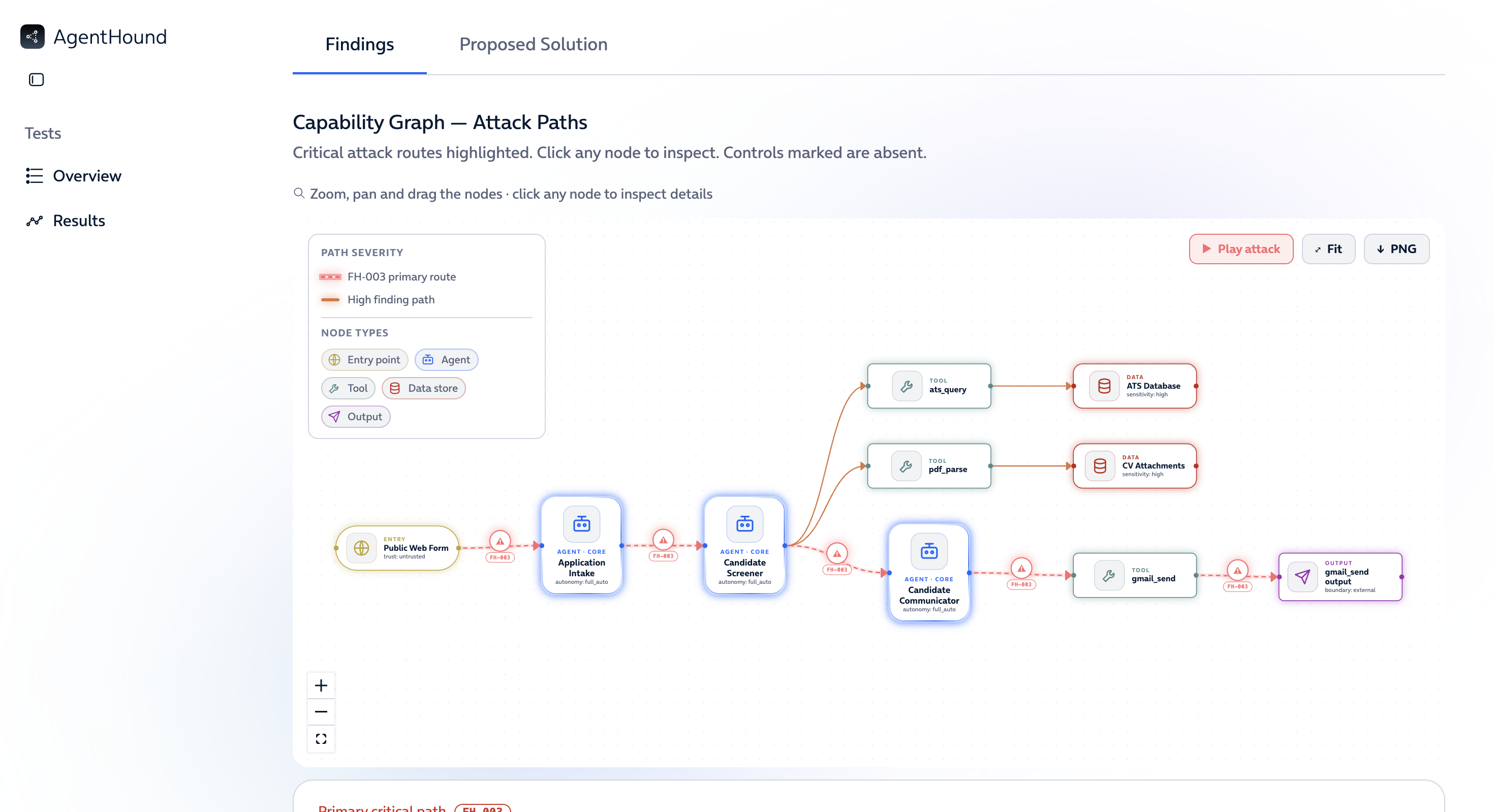
"Generic YAML" is not a third-party framework but AgentHound's own explicit nodes/edges format: a thin authoring layer over the internal model that the framework adapters also target, and the most expressive of the four (it can describe full capability paths the tree-shaped adapter outputs cannot). It is auto-detected from top-level nodes and edges.
Repository layout
Backend/— FastAPI backend service (Pydantic v2 + NetworkX). SeeBackend/app/docs/README.mdfor backend-only details.Frontend/— Next.js + Mistica web app. The threat-model wizard uploads an architecture YAML, calls the backend, and renders the capability graph, findings, and risk metrics. SeeFrontend/README.md.examples/— Engine-verified example architectures (four progressive scenarios as CrewAI, Dify, LangGraph, and generic YAML, plus a risky/safe pair migrated from an earlier proof of concept) with per-scenario notes, usable as a demo set and regression bank. Seeexamples/README.md.
Status
The backend is implemented: generic YAML parser, normalized IR, NetworkX graph, the v0.2 rule catalog (35 rules across path, node and edge patterns) with each finding classified as an attack path or a hygiene/compliance signal, numeric scoring, and the read API. Analysis is two-stage: POST /analyses parses the YAML into a stored graph, then POST .../analyze runs the rule engine (GET .../graph, GET .../findings read the result).
The frontend is linked to the backend: the wizard performs a real analysis end-to-end (upload → parse → review/correct capabilities in the Inference step → analyze → rendered results). The Inference step's capability edits feed the analyzed graph, so the findings, scores, and counts follow the user's corrections. Phase 2 (control recommendation + simulation) is implemented on both sides — the backend serves GET .../controls/recommendations and POST .../simulate-controls, and the UI's "Proposed Solution" tab renders the live before/after metrics, remediation timeline, and mitigated graph. Phase 3 adapters (CrewAI, Dify, LangGraph) are implemented; generic-format YAML is also processed (see Try it).
Running locally
The app is two processes: the backend API on port 8000 and the frontend dev server on port 3000. Start the backend first, then the frontend. The backend allows any localhost origin by default, so no extra configuration is needed for local development.
For local development the recommended backend runtime is a Python virtual environment (it pairs naturally with the pnpm frontend over localhost). A Docker image is also provided for a self-contained backend run; see Backend option B.
Backend (option A: venv — recommended)
Requires Python 3.11+.
# from Backend/
python -m venv .venv
. .venv/bin/activate            # Linux/macOS
# .venv\Scripts\Activate.ps1    # Windows (PowerShell)
pip install -e ".[dev]"
uvicorn app.main:app --reload
The API is now at http://127.0.0.1:8000 (Swagger UI at /docs, health at /health).
Backend (option B: Docker)
# from Backend/
docker build -t agenthound-backend .
docker run -p 8000:8000 -v "$PWD/data:/data" agenthound-backend
Frontend
Requires Node.js 20+ and pnpm (the repo pins pnpm@11).
# from Frontend/
pnpm install
pnpm dev
Open http://localhost:3000 and go to New model to run the wizard.
The frontend targets http://localhost:8000 by default. To point it at a
different backend, set NEXT_PUBLIC_AGENTHOUND_API_URL (e.g. in
Frontend/.env.local):
NEXT_PUBLIC_AGENTHOUND_API_URL=http://localhost:8000
Backend environment variables
| Variable | Default | Purpose |
|---|---|---|
AGENTHOUND_CORS_ORIGINS | any localhost origin | Comma-separated exact origins to allow (set for a non-localhost frontend). |
AGENTHOUND_DATA_DIR | ./data | Where analyses are persisted as JSON. |
AGENTHOUND_MAX_UPLOAD_BYTES | 2097152 (2 MiB) | Maximum accepted upload size. |
Testing
Backend (pytest):
# from Backend/ (venv active)
pytest
Frontend (type-check, lint, and unit tests):
# from Frontend/
pnpm test:ts
pnpm lint
pnpm test
Try it
The end-to-end path works today with generic-format YAML (top-level nodes/edges; the backend auto-detects the generic framework). A ready fixture ships in the repo:
# from Backend/ (backend running on :8000)
# 1. Parse the YAML into a stored graph (no rules run yet: findings are 0).
curl -F "file=@tests/fixtures/hiresmart_generic.yaml" http://127.0.0.1:8000/analyses
# -> {"analysis_id": "...", "status": "parsed", "summary": {...}}
# 2. Run the analysis (empty body = analyze the parsed graph as-is; send a
#    {nodes, edges} body to analyze an edited graph). This produces the findings.
curl -X POST http://127.0.0.1:8000/analyses/<analysis_id>/analyze
curl http://127.0.0.1:8000/analyses/<analysis_id>/graph
curl http://127.0.0.1:8000/analyses/<analysis_id>/findings
In the UI, upload the same fixture and select the n8n framework (which routes to backend auto-detection for this generic-format file). CrewAI, Dify, and LangGraph are supported by the Phase 3 adapters. The CrewAI config step accepts its native two files (agents.yaml + tasks.yaml); the wizard merges them into the single agents:/tasks: document the backend ingests.
For the full REST contract, IR schema, and rule/scoring details, see Backend/app/docs/.
License
AgentHound is released under the GNU Affero General Public License v3.0 (AGPL-3.0). See LICENSE for the full text.
Disclaimer: AgentHound is provided "as is", without warranty of any kind, and is intended for authorized security assessment and educational use only. You are responsible for ensuring that your use complies with all applicable laws and that you have permission to analyze the systems and configurations you submit. See LICENSE for the complete warranty disclaimer and terms.
The web UI is built with the @telefonica/mistica design system, which is itself MIT-licensed.
Third-party dependencies remain under their own licenses. Their attribution notices are collected in THIRD-PARTY-NOTICES.txt, with per-ecosystem summaries and regeneration instructions in Docs/licenses/.
AgentHound alternatives
View more →Similar ai agents in Research & Analysis, ranked by GitHub stars. Compare licence, recent activity and scan status before you choose.
| Name | Stars | Licence | Last updated | Scan |
|---|---|---|---|---|
| AgentHound (this page) Telefonica | 17 | AGPL-3.0 | Jul 22, 2026 | Scanned, no flagged issues |
| Hermes Agent NousResearch | 259k | MIT | Nov 1, 2026 | Scanned, no flagged issues |
| Anything LLM Mintplex-Labs | 68k | MIT | Oct 30, 2026 | Scanned, no flagged issues |
| Khazix Skills KKKKhazix | 22k | MIT | Oct 1, 2026 | Scanned, no flagged issues |
| Hermes Webui nesquena | 19k | MIT | Nov 1, 2026 | Scanned, no flagged issues |
| DocsGPT arc53 | 18k | MIT | Nov 1, 2026 | Scanned, no flagged issues |