Atom AI Agent
 by rush86999
Atom Agent, Open-Source Governed AI Agent Platform for Self-Hosted Automation
Atom is an open-source ai agent by rush86999, written mainly in Python, with 910 GitHub stars and the AGPL-3.0 license. Its code was last updated Nov 1, 2026.
Atom — Open-source AI agents with built-in governance
Train AI agents for the way your business works.
Teach agents your processes, give them relevant business context, and review the work—with built-in AI governance.



Try locally · See the workflows · What's verified · Report an issue
</div>Start with a job you already do
Atom helps you build AI agents around the way your team works: the files they use, the rules they follow, the output you expect and the decisions that need your approval. It is open source and self-hosted, with business automation and AI governance in the same platform. For example, give Atom a price list to prepare a quote, or check an invoice against purchase and receiving records, then produce a document showing the result. Inspect the source records, calculations and output before using it.
Open source and self-hosted. Run your own copy and configure a supported local or hosted model. The starter sample below needs no model or cloud key.
Teach your rules. Review the work. Keep the context.
- Turn company data into deliverables. Demonstrated workflows map unfamiliar spreadsheet columns, calculate against source records and produce cited Word or PowerPoint documents within supported schemas.
- Make your rules reusable. Save field mappings, commercial terms and contextual lessons. New work adopts accepted corrections; active work keeps its accepted teaching snapshot.
- Handle work that needs an answer. Supported durable questions, approvals and waits survive restarts. Completed operations are retained, and uncertain effects need reconciliation before another attempt.
- Keep decisions reviewable. Author ordered policies in the canvas editor. Supported deterministic rules retain unresolved requirements rather than inventing an approval.
- Bring your own model. Configure a supported provider or local OpenAI-compatible endpoint. Model capability and permissions still matter; the starter sample needs no model or cloud key.
Atom's deployment model is single tenant: a locally owned workspace with user, role and workspace boundaries. The workflows below have recorded local or controlled-provider evidence. General autonomous judgment and universal business automation remain development goals.
Run the local sample → · Explore demonstrated workflows → · Check the evidence and limits →
Train an agent, then put its training to work
A new employee needs context: how your business operates, which records to use, what a good result looks like and when to ask for help. That is the experience Atom is building for AI agents.
In demonstrated workflows, you can:
- Teach your way of working. Save business rules, field mappings, commercial terms and document-format instructions for a selected agent.
- Give the job relevant context. Select authorized files and the accepted lessons that apply to the work.
- Review and correct. Inspect the sources, calculations and deliverable. Accept a correction as reusable teaching for later work in its matching scope.
- Keep control as work continues. Supported jobs retain their accepted teaching snapshot across a wait and restart. Revised teaching can apply to new work without silently changing the job already in progress.
Try it: run the sample below, then open Agents → Sample Quote Analyst → Training to inspect and edit its lessons. The teach-and-correct walkthrough shows the recorded behavior and its evidence.
Training here means reusable lessons and business context supplied to the agent. The demonstrated behavior does not require retraining the underlying model. The end goal is unrestricted autonomy, with domain-specific exceptions: agents earn independent responsibility through assessment and verified work, while required review and supervision remain explicit for applicable domains. See agent training and graduation for the maturity stages, review process and implementation references. General employee-like judgment and broad autonomous competence remain development goals.
AI governance: control what agents can do
Useful AI needs more than a convincing answer. It needs boundaries around data, actions and authority. Atom brings AI governance into the execution path through permissions, policy checks, human approval checkpoints and durable audit records on supported paths. A model proposal is not permission to act.
- Human-in-the-loop approvals: supported governed actions pause for a bound review; missing, rejected or mismatched approval cannot authorize the action.
- Reviewable execution: supported results retain source and operation provenance. Unresolved requirements block completion and dependent reports.
- Controlled autonomy: the agent graduation system connects readiness evidence and authorized promotion with maturity stages. Broad autonomous competence remains a development goal.
These are engineering controls with recorded acceptance boundaries, not a claim of regulatory certification or universal protection against AI risks.
An agent framework beyond a single task
Quotes and invoices make the behavior easy to inspect; they are examples, not an industry restriction. The broader project covers multi-agent orchestration, durable workflows, agent memory, human oversight, BYOK model and cost routing, MCP tools, and business integrations. Availability and qualification differ by feature and release profile; a registered capability does not mean every connected service or autonomous use case is verified.
Start with the demonstrated workflows below. Consult the evidence and limits before relying on a broader capability in production.
Try Atom locally
Prerequisites: Git, Make, Python 3.11–3.13 (3.11 recommended), Node.js 20.9+ and npm. Python 3.14 is not supported by this dependency set.
git clone https://github.com/rush86999/atom.git
cd atom
PYTHON=python3.11 make setup
make dev
In a second terminal, from the same atom directory:
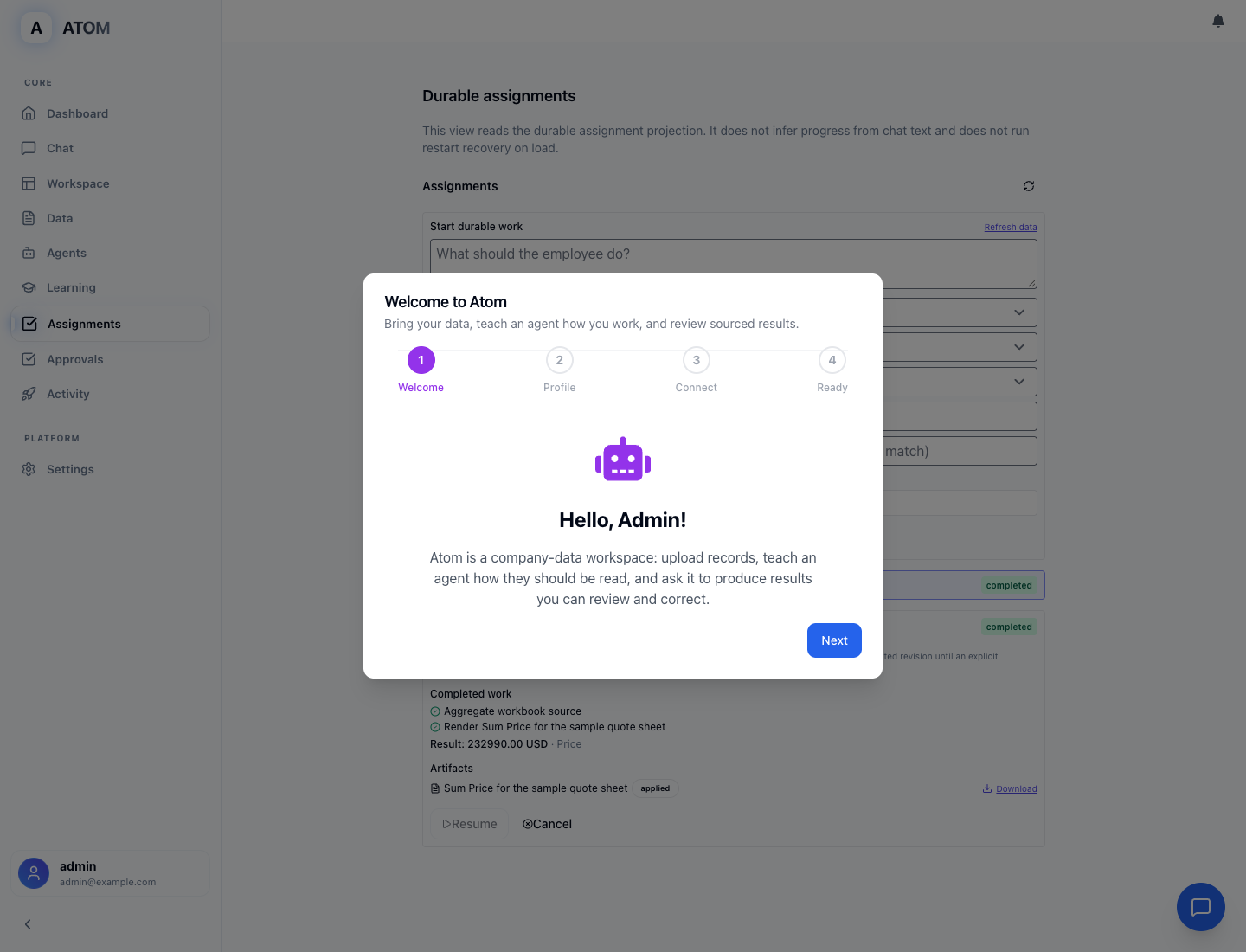
make sample
Open http://localhost:3001. Sign in as admin@example.com using the
generated password in backend/logs/bootstrap_admin_password.txt. Open
Assignments to find the completed sample and download its Word document.
Your first result: Sample Quote Analyst reads
sample-workspace/sample_quote.csv,
calculates 232990.00, and creates a DOCX. Its lessons are editable under
Agents → Sample Quote Analyst → Training. The sample uploads local data
and creates local records/artifacts; it sends no email and needs no connected
account or cloud credential.
If the default ports are busy, use the same pair for startup and the sample:
BACKEND_PORT=8101 FRONTEND_PORT=3101 make dev
# Second terminal:
make sample PORT=8101 FE_PORT=3101
Then open http://localhost:3101. Stop the development processes with Ctrl+C;
restart with make dev against the same checkout to keep your local data.
Do not delete the database or generated keys to troubleshoot an existing install.
Measured first use: approximately 5 min 15 s on one fresh-worktree run with warm package caches, including setup, startup, sample and browser access. 15 minutes is a cold-install target, not a measured guarantee. See the setup guide and measured first-use record.
See what an employee can do
| Workflow | What the recorded acceptance demonstrates |
|---|---|
| Sales quote | Unfamiliar columns → confirmed mapping → source-grounded total → formatted document; corrected teaching applies to new work. |
| Grant review | A second business domain uses the same teaching, calculation, clarification and artifact mechanisms. |
| Workbook editing | A tested 24-sheet workbook preserves identifiers and formulas through supported recalculation, export and restart/reopen. |
| Long-running assignment | More than two hours waiting, real backend restarts, the same assignment resumes, completed source work is retained and one controlled effect is recorded. |
| Learn from conversations | Review a persisted email thread, resolve referenced resources, confirm a lesson and apply it only in its accepted context. |
The demo guide distinguishes reproducible steps from historical runs and lists their exact sources. The two-hour run is elapsed/recovery evidence on its recorded source; later budget repairs have their own focused verification.
What you can rely on
111 of 123 frozen functional claims (90.2%) were accepted within the documented local and controlled-provider configurations. This is a source-bound feature coverage milestone, not a promise of 90% accuracy or universal reliability.
| Reference | Purpose |
|---|---|
successor-first-use-2026-11-01 | Recommended reproducible snapshot with the correctness and first-use fixes. |
accepted-local-2026-11-01-90pct | Immutable historical acceptance reference; its later-discovered budget defect is documented. Prefer the repaired successor for use. |
| Acceptance and repairs | Exact identities, independent checks and scope. |
| Frozen feature inventory | Verified, partial and excluded claims; denominator unchanged. |
| Successor release notes | Changes from the baseline and first-use measurements. |
To use the fixed snapshot rather than development main, run
git checkout successor-first-use-2026-11-01 before make setup.
Recent verified progress
Development main also includes newer, separately scoped evidence. These do
not change the frozen 111/123 score or qualify universal employee judgment.
| Capability | Verified boundary |
|---|---|
| Stored-text document exports | An ordinary TXT upload, open and reload journey verified downloads as Text, Markdown and JSON with current source-version binding. This exports stored text, not the original binary file; other formats and grounding remain separately qualified. |
| Information-triggered continuation | An ordinary source-answer UI episode preserved the same task, wait and source version through a real restart; an authorized answer triggered continuation to one verified task effect and final UI. Model responses were controlled, not a model-quality benchmark. |
| Goal controls | Ordinary UI goal set, ranking, reload and clear, with a member read-only/refusal twin. Analytics history used synthetic fixtures. |
| Backup and restore | A normal application child-process restart verified restored records and exact document bytes in an isolated local world; this is not whole-app disaster-recovery or crash-durability qualification. |
| Model-routing feedback | Scoped business verdicts and shared conditional updates have SQLite and targeted PostgreSQL verification. Grounding support, unresolved decisions and satisfied business outcomes remain distinct. Served multi-model quality is still open. |
See the current completion and evidence map for exact source identities, retained negative results and remaining requirements.
Long-running coordination: the product goal
A task should be able to request a missing fact from an authorized person or system, wait durably without repeated prompting, continue independent work, and resume the same task when the relevant information arrives—even after days of waiting and application restarts. It may need several request/wait/resume cycles before delivering a verified result. This is a general app goal with bounded demonstrations, not a claim of universal autonomous coordination or live third-party outreach.
For example, a customer quote may depend on a vendor's availability, price and lead time. Once authorized information arrives, dependent work should calculate landed cost and the taught margin or markup, then prepare a quote with supported lead-time assumptions. Procurement is only an illustration: the same mechanism must handle dependencies, facts and outputs across domains. It must never invent missing values, treat an unanswered request as completion, or send/order/spend without the required authority. See TASK-WAIT-01 acceptance requirements.
Clear boundaries
- The demonstrated local topology is single worker. Multi-worker execution and long soak behavior are not qualified.
- The sample and main acceptance campaigns use local or controlled providers. Deterministic taught policy is qualified separately from discretionary model judgment; the tested small-model judgment configuration failed qualification.
- One specifically authorized Outlook send and Microsoft read-only ingestion were separately qualified. That does not qualify every connector, broader live sending, autonomous live sending or independent recipient delivery.
- Supported workbook formulas and taught schemas are bounded. Arbitrary Excel compatibility, arbitrary schema understanding and UI-taught rounding are not promised.
- The broader platform includes workflow, routing, graph, governance and
integration surfaces. Some need
ATOM_PRODUCT_PROFILE=full, a configured provider or additional infrastructure. Consult the inventory before relying on a particular feature.
Common questions
Is Atom an AI agent framework or an AI employee app?
Both: the employee workspace uses the app's shared agent, tool, workflow and governance mechanisms. “AI employee” describes the business-facing experience; it is not a separate replacement for the agent framework.
Can I use it with a local model?
Yes. Atom supports local inference through configured routes, including Ollama. A model must meet the workload's capability requirements; local availability alone does not establish reliable business judgment.
Can an agent wait for information for days?
Durable wait/restart/answer workflows are demonstrated at their recorded scopes. General days-long coordination with external people and systems is an explicit acceptance goal. It is not yet a universal capability claim.
Does running locally keep all data on my computer?
Local storage and local inference can support a local workflow. If you configure a cloud model or connector, the data you send follows that service's terms and your authorized access. See security boundaries.
Connect your own data and models
After the sample, open Settings to configure a provider and the connections you need. Provider usage and connector access depend on your account and permissions. Keep credentials out of issues, screenshots and commits.
For local inference, see Run with Ollama. For connected Office work, see Office automation and OAuth setup. Local storage does not make cloud inference private: data sent to a configured provider follows that provider's terms.
Documentation and contributing
- Documentation hub · Quick start
- Verified workflow walkthroughs
- Troubleshooting
- Architecture · Security boundaries
- Brennan business-workflow engineering orders
- Contributing · Open an issue
For a useful bug report, include the commit/tag, operating system, launch command, expected result and a minimal sanitized example. Please do not include passwords, tokens, private documents or your database.
Atom is already public on GitHub under AGPL v3. Hosted deployment is separate from the verified local setup. If this project helps your work, star the repository, try a real workflow and tell us where it gets stuck.
Atom alternatives
View more →Similar ai agents in Productivity & Workflow, ranked by GitHub stars. Compare licence, recent activity and scan status before you choose.
| Name | Stars | Licence | Last updated | Scan |
|---|---|---|---|---|
| Atom (this page) rush86999 | 910 | AGPL-3.0 | Nov 1, 2026 | Scanned, no flagged issues |
| Paperclip paperclipai | 110k | MIT | Nov 1, 2026 | Scanned, no flagged issues |
| Ppt Master hugohe3 | 72k | MIT | Oct 30, 2026 | Scanned, no flagged issues |
| Llama Index run-llama | 53k | MIT | Oct 26, 2026 | Scanned, see report |
| Nanobot HKUDS | 50k | MIT | Oct 31, 2026 | Scanned, no flagged issues |
| Sim simstudioai | 30k | Apache-2.0 | Nov 1, 2026 | Scanned, see report |