Buywise Agent
 by saltsalt123
A langGraph-powered multi-agent RAG assistant for warranty, return, and consumer decision workflow.
Buywise Agent is an open-source ai agent by saltsalt123, written mainly in Python, with 117 GitHub stars and the MIT license. Its code was last updated Sep 26, 2026.
BuyWise Agent MVP 🤖🛒
<p align="center"> <a href="https://github.com/saltsalt123/buywise-agent/actions/workflows/ci.yml"><img src="https://github.com/saltsalt123/buywise-agent/actions/workflows/ci.yml/badge.svg?branch=main" alt="CI"></a> <img src="https://img.shields.io/badge/python-3.10%2B-blue" alt="Python 3.10+"> <img src="https://img.shields.io/badge/license-MIT-green" alt="MIT License"> <img src="https://img.shields.io/badge/framework-LangGraph-6C5CE7" alt="LangGraph"> <img src="https://img.shields.io/badge/framework-LangChain-00B894" alt="LangChain"> <img src="https://img.shields.io/badge/API-FastAPI-009485" alt="FastAPI"> <img src="https://img.shields.io/badge/status-MVP-yellow" alt="MVP Status"> <img src="https://img.shields.io/badge/PRs-welcome-brightgreen" alt="PRs Welcome"> <img src="https://img.shields.io/github/last-commit/saltsalt123/buywise-agent" alt="Last Commit"> </p>A LangGraph multi-agent RAG assistant for warranty/return decisions — local-first, demo-ready.
Version status.
v0.1.0is the backend warranty/return MVP. Currentmainadds the local Streamlit UI viamake ui.
🎯 What It Does
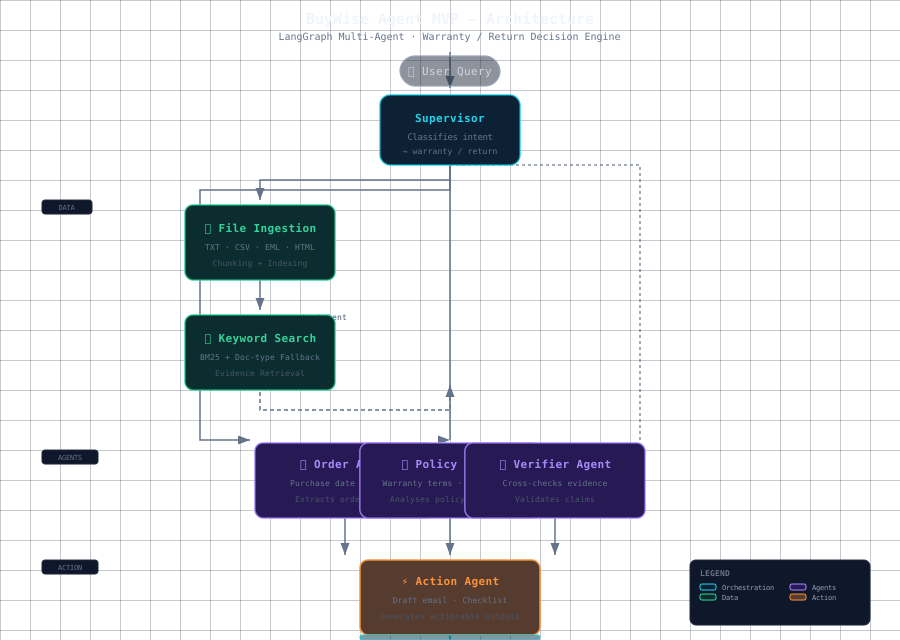
Upload a receipt + warranty card + policy → ask "can I still return/warranty this?" → system runs 4 agents to produce an evidence-backed answer with action drafts.
This is the MVP (Minimum Viable Product). It covers the warranty/return decision scenario end-to-end. Price monitoring, review summarization, and async workers are planned for later phases (see Roadmap).
🧠 Architecture (MVP)
🎬 Live Demo

Click the image above to watch the interactive terminal demo — project structure overview + headphone warranty/return case run.
🚀 Quickstart
# 1. Install (MVP core deps only). The Makefile uses $(PYTHON), which defaults to
#    `python3` — activate the venv so it resolves to the project interpreter, or
#    override per run: make demo PYTHON=python3.10
#    If `python3 -m venv` has no ensurepip (Debian/Ubuntu need python3-venv), the venv
#    comes out without pip and `source` fails — leaving pip to install globally. Use
#    `virtualenv .venv` instead, and check `which python3` points inside .venv.
python3 -m venv .venv && source .venv/bin/activate
pip install -e ".[dev]"

# 2. Run the test suite
make test
# The strict gate CI uses: fails on any skip or a shrunken suite
make test-ci

# 3. Run the warranty demo
make demo

# 4. Try the laptop return case
make demo-laptop

# 5. Run eval (2 positive cases x 4 metrics + 5 negative cases)
make eval

# 6. Start FastAPI server
make dev

# 7. Minimal Streamlit UI (browser, local only)
make ui                # http://localhost:8501

# 8. (optional) Full stack: API + PostgreSQL + Redis via Docker
cp .env.example .env   # docker compose requires this file to exist
make up                # the Streamlit UI is separate — run `make ui` for that
🖥️ Streamlit UI
pip install -e ".[dev]"
make ui                # http://localhost:8501
Drop in a receipt / warranty card / return policy / support email (.txt, .pdf, .csv,
.eml, .html), type a question, and press Analyze — or press Load headphone sample
/ Load laptop sample to run a bundled case in one click. The page shows the status, the
confidence, the summary, key facts, verified and unsupported claims, drafted actions (with the
draft email body), and every retrieved evidence chunk with its source_id, doc_type and
chunk_id.
Two things worth knowing:
- Uploads land in
data/uploads/session_<id>/(git-ignored). That directory is one of theSAFE_SOURCE_ROOTSthe HTTP API also enforces, so an uploaded file is readable by the workflow and nothing outside those roots ever is. A file name arrives from a browser as untrusted input: anything carrying a directory component, an absolute path or a disallowed extension is refused rather than silently rewritten. - Everything runs in-process against the local workflow. No external APIs, no account, no
telemetry —
.streamlit/config.tomlturns usage reporting off so the first run does not prompt for an email address.
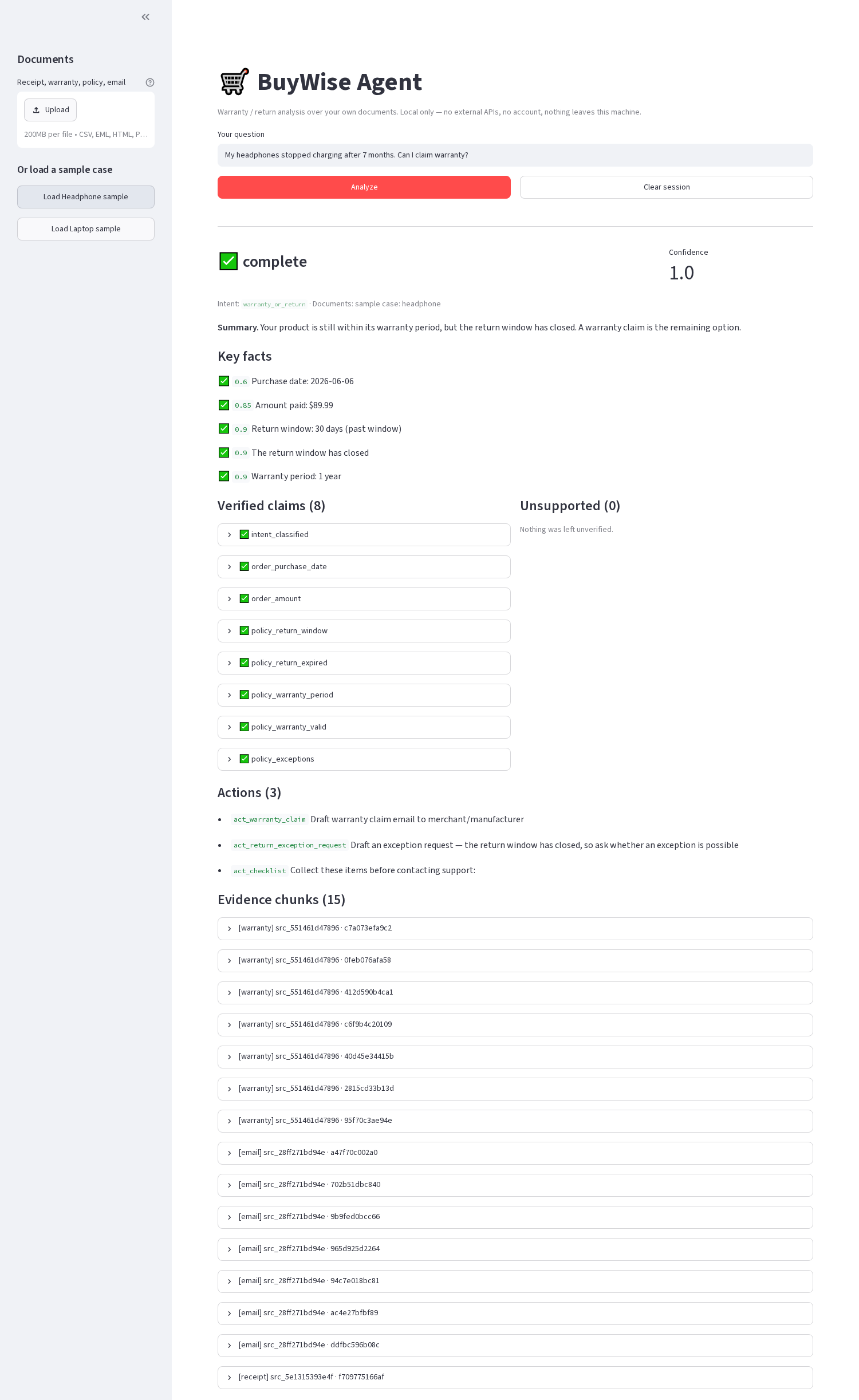
make ui — upload your own documents or load a bundled sample case, then read the analysis.
📸 Demo Output
  BuyWise Agent MVP — Warranty/Return Demo

  📄 Source: headphone_warranty_case/
  💬 Query:  My headphones stopped charging after 7 months.
             Can I claim warranty?

  ────────────────────────────────────────────────────────
  📊 ANALYSIS RESULT
  ────────────────────────────────────────────────────────
  Intent:        warranty_or_return
  Evidence used: 15 chunks
  Confidence:    1.0

  📋 Key Facts:
    ⚠️  [0.9] Intent classified as: warranty_or_return
    ✅ [0.6] Purchase date: 2025-11-10
    ✅ [0.7] Warranty period: 1 year

  📝 Suggested Actions:
    🔓 [draft_email] Draft return/refund request to merchant
    🔓 [export_report] Collect these items before contacting support
📡 API Usage
POST /api/chat
source_dirs entries must resolve inside SAFE_SOURCE_ROOTS (default:
sample_data/). Absolute paths, .. traversal and symlinks that escape the allowed root
are refused with 400 before the workflow is entered — the service will not read an
arbitrary path off the filesystem.
curl -X POST http://localhost:8000/api/chat \
  -H "Content-Type: application/json" \
  -d '{
    "query": "My headphones stopped charging after 7 months. Can I claim warranty?",
    "source_dirs": ["sample_data/headphone_warranty_case"]
  }'
# Refused: outside the allowed roots
curl -X POST http://localhost:8000/api/chat \
  -H "Content-Type: application/json" \
  -d '{"query": "x", "source_dirs": ["/tmp/loopcase"]}'
# 400 {"detail": "source_dirs entry '/tmp/loopcase' is outside the allowed roots (.../sample_data)"}
Response (JSON) — actual output for the request above:
{
  "status": "complete",
  "intent": "warranty_or_return",
  "summary": "Your product is still within its warranty period, but the return window has closed. A warranty claim is the remaining option.",
  "key_facts": [
    {"text": "Purchase date: 2025-11-10", "confidence": 0.6, "supported": true},
    {"text": "Amount paid: $89.99", "confidence": 0.85, "supported": true},
    {"text": "Return window: 30 days (past window)", "confidence": 0.9, "supported": true},
    {"text": "The return window has closed", "confidence": 0.9, "supported": true},
    {"text": "Warranty period: 1 year", "confidence": 0.9, "supported": true}
  ],
  "actions": [
    {"action_id": "act_warranty_claim", "type": "draft_email",
     "description": "Draft warranty claim email to merchant/manufacturer",
     "requires_approval": false},
    {"action_id": "act_return_exception_request", "type": "draft_email",
     "description": "Draft an exception request — the return window has closed, so ask whether an exception is possible",
     "requires_approval": false},
    {"action_id": "act_checklist", "type": "export_report",
     "description": "Collect these items before contacting support:",
     "requires_approval": false}
  ],
  "evidence_count": 15,
  "confidence": 1.0
}
confidence is the share of claims the verifier could support
(verified / (verified + unsupported)). It is 0.0 when no claim is supported — a run
with no documents reports status: "no_evidence" and confidence: 0.0, never 1.0.
status is one of complete, needs_human_review (the documents contradict each other),
no_evidence, insufficient_evidence, or unsupported_intent (a recognised but
unimplemented intent short-circuits).
GET /health
curl http://localhost:8000/health
# {"status": "ok", "service": "buywise-agent-mvp"}
📊 Eval (current)
make eval runs two suites and reports them separately.
Positive cases (2 cases × 4 metrics) — both at 1.0:
- Evidence Recall: 1.0 — all gold keywords found in retrieved evidence
- Forbidden Claim Avoidance: 1.0 — no hallucinated claims
- Action Generation: 1.0 — expected action types all present
- Confidence Reported: 1.0 — confidence always populated
Negative cases (5) — each passes when the system refuses to answer as if it had evidence. An eval that only prints "8/8" says nothing about whether the system knows when to stop, so these are reported explicitly:
| case | what it pins down |
|---|---|
neg_001_no_documents_at_all | empty source dir → status=no_evidence, no documents drafted, confidence=0.0 |
neg_002_nothing_parsable | dir with only .bin/.png → same |
neg_003_unimplemented_intent | purchase query → status=unsupported_intent, no actions, no key facts |
neg_004_loop_guard_terminates | unsupported claims → returns, retrieval_attempts<=2, no hang |
case_contradictory_policy | receipt grants a 30-day window while the merchant's policy is final sale → status=needs_human_review, no act_return_request, conflict recorded, confidence<=0.5, summary explains the disagreement |
Results are written to eval/reports/latest.md.
✅ CI & Development checks
Every push to main and every pull request runs
CI on Python 3.10,
3.11 and 3.12: lint, the strict test check, and the eval suite.
Recommended locally before pushing:
make lint       # ruff
make test-ci    # pytest, but a skip or a shrunken suite fails the run
make eval       # 2 positive cases x 4 metrics + 5 negative cases
make test is the everyday run — it reports skips and keeps going. make test-ci is the
gate: it fails if any test is skipped, and if the passing count falls below the expected
total (417). That strictness is not pedantry. A test-only dependency (reportlab) was
missing from the dev extra, its module-level pytest.importorskip turned fourteen
parser-robustness tests into one module skip, and the run reported
353 passed, 1 skipped with exit code 0 — a smaller suite wearing a green face. make test-ci exists so that cannot happen again, in CI or on a laptop.
📁 Structure
buywise-agent/
├── agent/              # LangGraph workflow
│   ├── graph.py        # 7-node graph with loop guard
│   ├── state.py        # Pydantic data models
│   ├── textnorm.py     # Shared tokenising / stopwords / IDF
│   └── agents/         # supervisor + 5 specialists (order, policy, product, verifier, action)
├── assets/             # Architecture diagram (SVG + HTML)
├── ingestion/          # Doc parsing
│   ├── doc_type.py     # One place that decides what a document is
│   ├── parsers/        # File parsers (PDF, CSV, EML, HTML, TXT)
│   └── labels.py       # Label/value extraction
├── retrieval/          # IDF-weighted keyword search + rerank + compress
├── apps/
│   ├── safe_paths.py   # The one place that decides which directories may be read
│   ├── api/            # FastAPI backend (2 endpoints, path whitelist on /api/chat)
│   └── ui/             # Streamlit UI (uploads.py holds the path rules, no streamlit import)
├── eval/               # Eval suite (2 positive cases x 4 metrics + 5 negative cases)
├── tests/              # Pytest suite (417 tests)
├── sample_data/        # 2 populated synthetic cases + 1 empty fixture directory
├── scripts/demo.py     # CLI demo runner
├── docker-compose.yml  # API + PostgreSQL + Redis (Streamlit UI runs separately via make ui)
└── Makefile
🛣️ Roadmap (post-MVP)
- Phase 4: Full pgvector + BM25 hybrid retrieval. The in-memory retriever is still
lexical and that is its ceiling: ranking is now IDF-weighted over content terms with
stop-words removed and token-boundary matching (
agent/textnorm.py), so filler can no longer outrank a policy sentence and"i"no longer matches every word containing it — but a chunk that shares no content term with the query still scores zero. Recall reads 1.00: 0.60 → 0.90 came from raising the measured budget (top_k=20 / max_chunks=15), and the last 0.10 from correcting a gold keyword that never matched the data — the case asked for "May 15" while the files store ISO dates (2026-05-15). Embedding retrieval remains unimplemented; that is what would handle paraphrase and synonyms. - Phase 5: Price monitor + deadline watch agents → proactive alerts
- Phase 6: Async workers (Celery) + review summarization agent
- Phase 7: richer web UI / Next.js polish; minimal Streamlit upload UI has shipped in apps/ui/
- Phase 8: Replace the keyword-based intent classifier with an LLM/embedding
classifier. Substring matching cannot generalise — every inflection whose stem is
respelled (
charging,broke,warranties,stopped working) has to be listed by hand, and an unseen phrasing such as "my phone just died" still falls through togeneral_qa. The keyword list is a stop-gap, not a classifier.
To install extras for later phases:
# For vector DB / async workers (Phase 4+)
pip install -e ".[pgvector]"

# For advanced eval metrics (Phase 3+)
pip install -e ".[evalextra]"
🔧 Fixed in this round (P0/P1/P2 bug defence)
Each item below was reproduced by a failing test first, then fixed. The test file named in each row is the regression guard.
| # | Defect (measured before the fix) | Fix | Guard |
|---|---|---|---|
| 1 | Infinite loop. route_after_verify re-entered retrieve_evidence whenever claims were unsupported, but only ingest_and_index incremented retrieval_attempts — and it runs once. The counter stayed at 1 forever and the workflow never returned. | the counter advances in retrieve_evidence_node; the cap is named _MAX_RETRIEVAL_ATTEMPTS | test_workflow_loop_guard.py |
| 2 | Verifier rubber-stamp. elif claim.confidence >= 0.7: verified.append(claim) verified confident claims with no supporting chunk at all. Support was also a substring count, so sharing return/days was enough. | support requires token-boundary content overlap, and a claim asserting a quantity must find that quantity in the evidence | test_verifier_strictness.py |
| 3 | Timezone. Return windows were counted with datetime.utcnow(), so between 00:00–08:00 Beijing the UTC date lags and a window that had just closed still read as open. | policy_agent_now() returns Beijing time; the day comes from the Asia/Shanghai calendar | test_policy_timezone_boundary.py |
| 4 | Zero evidence looked like success. With no documents: status="complete", overall_confidence=1.0, and a drafted act_return_request — because the supervisor's own claim text ("Intent classified as: warranty_or_return") contains the word "return" and was read as evidence. | the intent claim is excluded from evidence heuristics; no documents → status="no_evidence" and confidence=0.0; the status is no longer overwritten with "complete" | test_zero_evidence_behavior.py |
| 5 | Filler outranked policy. Ranking counted raw query tokens as substrings, so a chunk repeating can/i/this/on/may beat "Return Window: 14 days from delivery", and "i" matched nearly any word. | IDF-weighted content-term ranking with stop-words and token boundaries; inclusion is unchanged so recall cannot shrink | test_retrieval_stopwords.py |
| 6 | Arbitrary file read. POST /api/chat passed source_dirs straight to the workflow, so a caller could have /tmp, /etc or a home directory parsed into the answer. | SAFE_SOURCE_ROOTS whitelist; resolved (symlinks + .. collapsed) and refused with 400 before the workflow runs | test_api_path_whitelist.py |
| 7 | Cross-request data leak. The retriever was a module-level _RETRIEVER singleton, so two requests in flight shared one corpus — the second index_chunks overwrote the first, and the doc-type fallback reads retriever._chunks. | the index is created per run and carried on the state | test_retriever_isolation.py, test_concurrent_requests.py |
| 8 | The verifier re-verified itself. Its own message carries the claims it already judged, and on the second pass those were collected again — so every claim appeared twice in unsupported_claims and the uncertainties list repeated itself. | claims from verifier_agent messages are skipped when collecting | test_golden_outputs.py |
| 9 | Contradictory documents were silently resolved. A receipt granting a 30-day window plus a policy stating final sale produced a normal act_return_request — the workflow picked whichever document it read first. | return-refusal wording becomes a policy_return_conflict claim; the action agent then refuses the plain return request, reports needs_human_review, caps confidence at 0.5 and explains the disagreement | test_golden_outputs.py, eval case_contradictory_policy |
| 10 | A plain-text policy was invisible. return_policy.txt was inferred as manual from its filename alone, and policy_agent only reads {warranty, policy, receipt} — so the return policy was dropped from every decision while the run still reported success. | inference moved into one function (ingestion/doc_type.py) consulted by every parser: extension → filename → content → extension default. The .txt body is now decoded before the type is decided. | test_doc_type_inference.py, test_text_policy_participation.py |
| 11 | A zero-day return window vanished. if decision.return_window_days: is falsy for 0, so "Return Policy: 0 days" — final sale stated in numbers — produced no window claim and no verdict at all. | the guard is is not None; a 0-day window is recorded, judged not-valid, and published as policy_return_unavailable, which routes to an exception request | test_zero_day_return_window.py |
| 12 | Most refusal wordings were invisible. Only 10 phrases were recognised, so "all sales are final", "not eligible for return", "clearance items cannot be returned", "exchange only" and "refunds are unavailable" read as a policy that says nothing about returns. | the refusal list covers plain, eligibility and exchange-only refusals; a refusal with a window is a conflict, a refusal alone is "returns unavailable" | test_return_refusal_patterns.py |
Suite: 417 tests (94 pre-existing, all still passing; the rest added over four rounds).
Known limits, stated rather than hidden:
- Verification is lexical. It cannot catch a semantic contradiction between two claims that happen to use the same words, and a derived verdict ("The return window has closed") is accepted on the strength of the terms it shares with its source document. Contradictory documents are detected by explicit refusal wording, not by reasoning about the conflict.
- The refusal list is still a phrase list. A merchant who refuses a return in a wording nobody has written down yet will not be detected; the list is extended by test, one wording at a time.
- Return-window and warranty periods are counted in whole days from the purchase date
(
days_since <= N), so a "1 year" warranty is 365 days, not a calendar year. - The
confidencefigure is a claim-support ratio, not a probability that the answer is right:verified / (verified + unsupported). The conflict cap is a separate, explicit ceiling rather than something derived from the ratio. retrieval_attemptsis a loop guard, not a quality gate — hitting the cap means "give the user the answer we have", not "the evidence is adequate".
⚠️ What This MVP Does NOT Do
- ❌ No multi-user / auth
- ❌ No real-time Gmail/Amazon integration
- ❌ No PostgreSQL/vector DB (runs with in-memory keyword search)
- ❌ No async background workers
- ❌ No purchase-decision flow (intent is detected, but returns
unsupported_intent) - ❌ No price monitoring or review analysis
- ❌ No web frontend (API + CLI only)
All of these are scoped for post-MVP phases.
⚠️ Disclaimer
BuyWise Agent provides evidence-backed consumer suggestions, not legal advice. Users must review all drafts before acting.
Buywise Agent alternatives
View more →Similar ai agents in Data Science & ML, ranked by GitHub stars. Compare licence, recent activity and scan status before you choose.
| Name | Stars | Licence | Last updated | Scan |
|---|---|---|---|---|
| Buywise Agent (this page) saltsalt123 | 117 | MIT | Sep 26, 2026 | Scanned, no flagged issues |
| Ragflow infiniflow | 93k | Apache-2.0 | Oct 31, 2026 | Scanned, no flagged issues |
| Cherry Studio CherryHQ | 53k | AGPL-3.0 | Nov 1, 2026 | Scanned, no flagged issues |
| PageIndex VectifyAI | 40k | MIT | Oct 29, 2026 | Scanned, no flagged issues |
| Graphiti getzep | 32k | Apache-2.0 | Nov 1, 2026 | Scanned, no flagged issues |
| Cua trycua | 31k | MIT | Nov 1, 2026 | Scanned, no flagged issues |