Solvent Agent
 by ianalloway
Offline-first Python AI agent that runs a tiny research business: quotes each job against its own costs, collects via Stripe, fulfils with NVIDIA Nemotron, pays vendors within a spend policy, and declines unprofitable work.
Solvent Agent is an open-source ai agent by ianalloway, written mainly in Python, with 112 GitHub stars and the MIT license. Its code was last updated Oct 31, 2026. The latest PyPI release is solvent-agent 0.3.1, published Oct 31, 2026, with 100 downloads last week.
🪙 SOLVENT
A Python agent that runs a tiny research business: it quotes each job against its own costs, gets paid through Stripe, pays its own vendor bills within a spend policy, and declines work that would lose money.









Quick Start · How It Works · Live Demo · Make It Real · Research
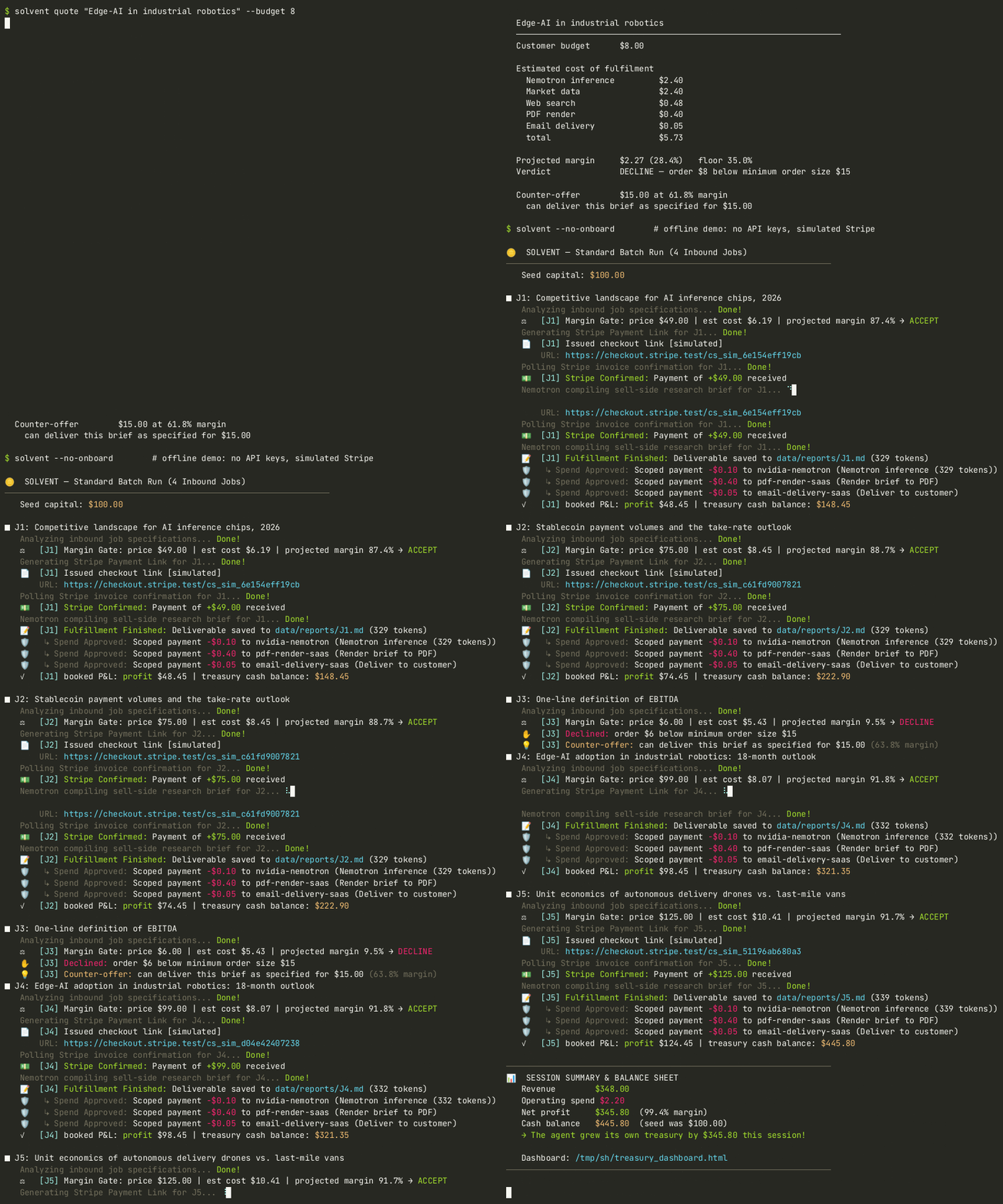
<sub>Recorded from the real CLI with no API keys and no network access: the Stripe checkout links and Nemotron output are the built-in offline stubs, and the dollar figures are simulated.</sub>
▶ Try it in your browser: the real package running in Pyodide, with no install and no keys.
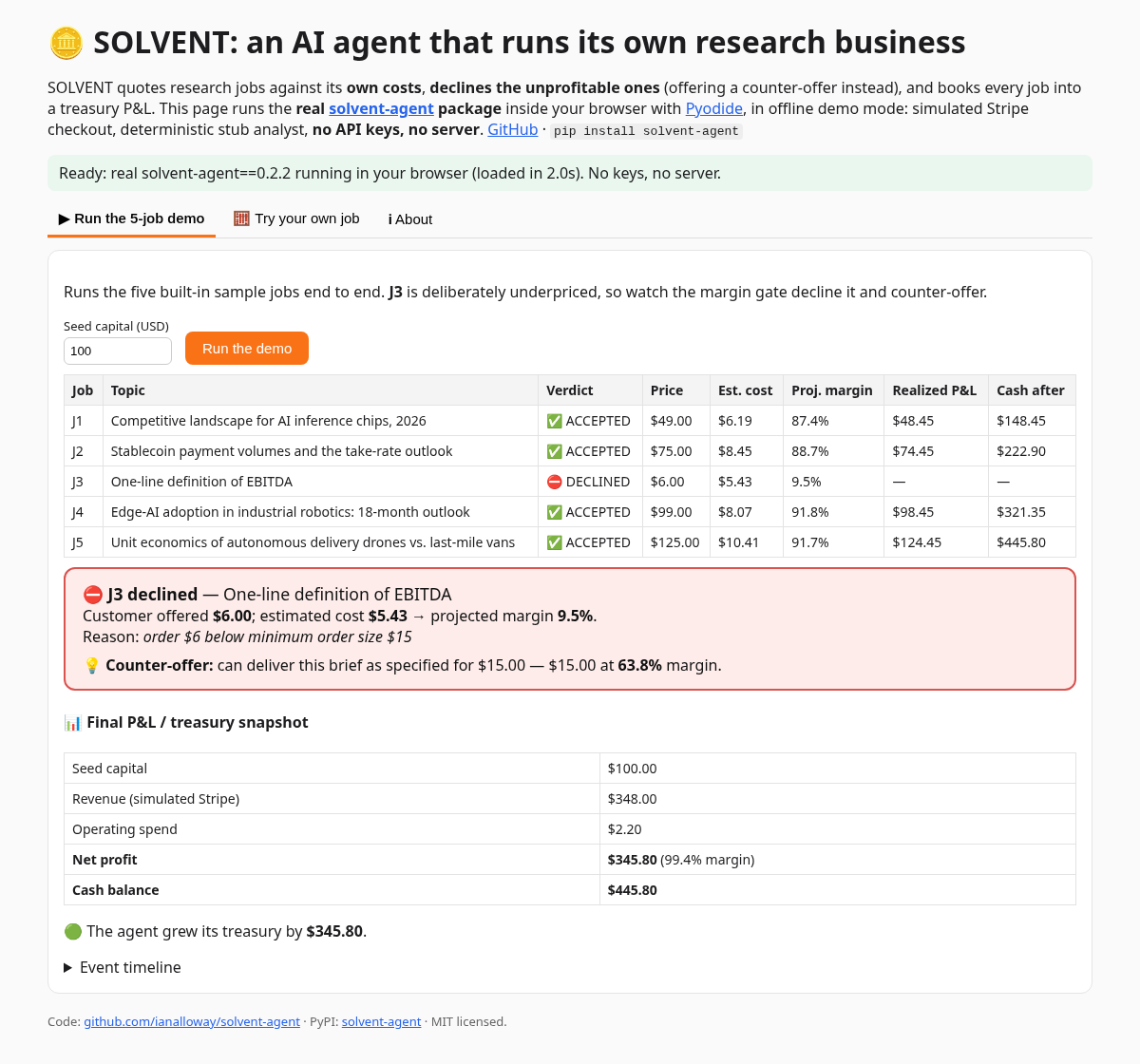
<sub>All dollar figures, including the final cash balance, are simulated.</sub>
</div>Demo by default. With no keys set,
solventruns an offline, zero-key simulation of the whole loop. Dollar figures in the demo are illustrative, not production revenue. Stripe test-mode Payment Links and live NVIDIA Nemotron are opt-in; see Make It Real.
🚀 Quick Start
30 seconds. No API keys. No dependencies beyond Python 3.10+.
pipx install solvent-agent      # or: pip install solvent-agent
solvent --no-onboard            # run the offline demo batch (skip the first-run wizard)
solvent finance                 # income statement, unit economics, runway
Then open the dashboard path the demo prints (~/.solvent/treasury_dashboard.html
for a pip/pipx install, or under $SOLVENT_HOME if you set it).
Try the margin gate on its own. This dry run declines an $8 order and returns a counter-offer that clears the margin floor:
solvent quote "Edge-AI in industrial robotics" --budget 8
| Command | What it does |
|---|---|
solvent | batch demo (onboarding wizard on first run; --no-onboard skips it) |
solvent init | create data dirs, treasury DB, and workspace files |
solvent status | live treasury summary (--watch to auto-refresh) |
solvent finance | income statement, unit economics, runway, forecast |
solvent quote | dry-run the margin gate on a job and price a counter-offer |
solvent guardrails | show the spend policy: vendor caps, velocity limit, job budgets |
solvent doctor | diagnostics: API keys, extras, workspace files |
solvent serve | webhooks + job API + hosted dashboard ([serve] extra) |
solvent worker | resume incomplete jobs / process the queue |
solvent jobs | list / show / retry / cancel jobs (jobs --help) |
solvent help | every command |
Or run from a source checkout:
git clone https://github.com/ianalloway/solvent-agent.git
cd solvent-agent
python3 run_demo.py              # batch demo (onboarding wizard on first run)
python3 run_demo.py --no-onboard # skip wizard when scripting
pip install -e .                 # editable install from a checkout
The demo runs a batch of 5 sample analyst jobs (4 accepted, 1 declined by the margin gate) through margin gating, simulated Stripe payment, Nemotron fulfilment (offline stub), guardrail screening, and live P&L, in about 30 seconds.
Third-party features are opt-in extras, so install only what you need:
pip install "solvent-agent[stripe]"    # real Stripe test-mode payment links
pip install "solvent-agent[serve]"     # FastAPI webhooks + hosted briefs
pip install "solvent-agent[telegram]"  # Telegram bot channel
pip install "solvent-agent[qr]"        # scannable QR codes for OpenClaw pairing
pip install "solvent-agent[dev]"       # pytest, for running the test suite
pip install "solvent-agent[all]"       # everything
When run from a source checkout, runtime data stays under <repo>/data. When
installed elsewhere, SOLVENT writes to ~/.solvent instead of into
site-packages; override either with SOLVENT_HOME=/path/to/dir.
First run: A short onboarding wizard asks you to choose a model, interaction mode, and whether to enable Stripe test mode. Preferences are saved to
.solvent/config.jsonand never committed.
The Big Idea
Most agents can spend money. Almost none can run as a business.
SOLVENT closes the full loop:
  Client pays Stripe → Agent earns revenue → Agent fulfils the work
  → Agent pays its own vendor bills → P&L booked → balance sheet grows
Every job is profit-gated before it starts. Unprofitable work is declined without touching Stripe. Vendor payments are screened by a NemoClaw-style policy sandbox, so the agent spends only out of revenue it has already collected.
📊 The Demo
After a run, the CLI prints the dashboard path. Open it in a browser:
open treasury_dashboard.html          # macOS (source checkout)
xdg-open treasury_dashboard.html      # Linux
# pip/pipx install: ~/.solvent/treasury_dashboard.html  (or $SOLVENT_HOME)
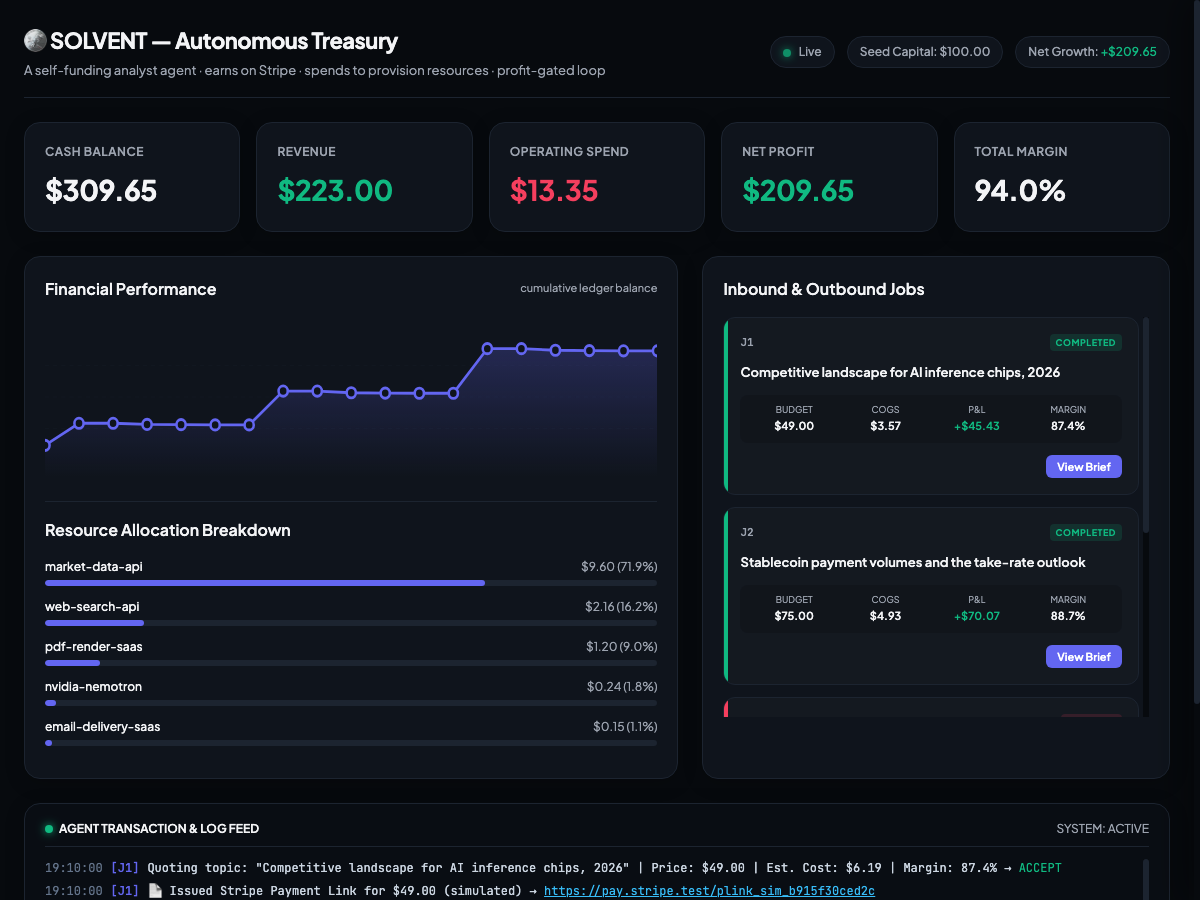
A typical offline demo batch (illustrative numbers from the simulated run — not production revenue):
| Metric | Demo value |
|---|---|
| Revenue | $348.00 |
| Operating spend | $2.20 (booked vendor spend) |
| Net profit | $345.80 (99.4% margin) |
| Jobs completed / declined | 4 / 1 (below minimum order size) |
<sub>From solvent --no-onboard on a fresh SOLVENT_HOME with no API keys. The 99.4% margin is higher than the gate's 87–92% projections because offline fulfilment makes no market-data or web-search calls; see #79.</sub>
⚙️ How It Works
 inbound job
     │
     ▼
 ┌─────────────┐   margin < floor?  ┌───────────┐
 │  MARGIN GATE│ ─────────────────▶ │  DECLINE  │
 │  (pricing)  │                    └───────────┘
 └─────┬───────┘ accept
       ▼
 ┌─────────────┐   EARN
 │   STRIPE    │ ── Payment Link → poll/webhook until paid ──▶ + revenue
 └─────┬───────┘    (records cs_... + pi_... on ledger)
       ▼
 ┌─────────────┐   FULFIL (each live request authorized before I/O)
 │  NEMOTRON   │ ── Llama-3.1-Nemotron-Ultra produces the brief ──▶ resource usage
 └─────┬───────┘
       ▼
 ┌─────────────┐   SPEND (every payment screened first)
 │ GUARDRAILS  │ ── NemoClaw policy: allowlist · caps · reserve · ROI
 │   → STRIPE  │ ── Issuing virtual card (test) or simulated spend ──▶ − expense
 └─────┬───────┘
       ▼
   BOOK P&L  ──▶ treasury updated · dashboard refreshed
The job pipeline checks payment before fulfilment and screens vendor payments against the configured spend policy. Quotes use estimated costs, so an accepted quote is a projected margin, not a guarantee of realized profit. The ledger and cost-calibration reports show how actual spending compares with that estimate.
🏗️ Architecture
| Layer | Technology | File |
|---|---|---|
| Analyst / reasoning | NVIDIA Nemotron (Llama-3.1-Nemotron-Ultra) | solvent/nemotron.py |
| Spend safety | NVIDIA NemoClaw-style policy sandbox | solvent/guardrails.py |
| Earn | Stripe Payment Links + Checkout Session polling | solvent/stripe_client.py |
| Spend | Stripe Issuing virtual cards (test mode) | solvent/stripe_client.py |
| Orchestration | Hermes / Nous tool-calling agent loop | solvent/agent.py |
| Memory | SQLite treasury + pricing ledger | solvent/treasury.py · solvent/pricing.py |
Key design choices:
- Structural profitability —
pricing.pycomputes unit cost before quoting. If margin < floor, the job never reaches Stripe. - Spend policy —
guardrails.pyenforces vendor allowlist, per-transaction cap, rolling 24h budget, minimum cash reserve, and no-negative-ROI rule. Live model and research-tool requests reserve their maximum modeled charge in SQLite before network I/O; retries and nested model calls each need authorization. Outstanding reservations count against shared and per-job budgets. Validated usage settles the charge atomically; a timeout is conservatively charged at the reserved maximum. Reservations left by a crashed worker remain held for reconciliation. - Delivery authorization — resource charges are booked before email or hosted publication. A checkout delivery token alone cannot retrieve an unfinished brief. Cached fulfillment retains resource charges for resume; legacy caches missing that accounting fail closed. Once a brief is published, delivery errors require review instead of an automatic refund. Successfully completed legacy jobs remain accessible.
- Offline-first — without API keys the demo runs on deterministic stubs. Add
NVIDIA_API_KEY+STRIPE_API_KEY=sk_test_...to unlock live inference and real Payment Links. - Audit trail — every
cs_...checkout session ID andpi_...PaymentIntent ID is recorded on the ledger before fulfilment begins.
Resource prices can be overridden in .solvent/pricing_overrides.json. Values
are costs in cents and must be finite, non-negative numbers; 0 is valid for a
free resource. Invalid entries (including negative values, booleans, NaN, and
infinity) keep the built-in price. Valid entries in the same file still apply.
📚 Documentation
| Guide | Covers |
|---|---|
| Running modes & operations | batch, interactive, programmatic, production (webhooks + worker), day-to-day ops |
| Commercial judgement | counter-offers, spend policy, per-job envelopes, backlog, win rate, selling |
| Configuration | live Stripe / Nemotron / local OpenAI-compatible models, environment variables, Telegram |
| Development | running the tests, repository layout |
| Production · Telegram · Retired Nano migration · Releasing | deeper operator guides |
🔑 Make It Real
With no keys, everything runs as an offline simulation. To use Stripe test-mode Payment Links, live NVIDIA Nemotron, or a local/OpenAI-compatible model, see docs/CONFIGURATION.md.
🔬 Research Use
SOLVENT's spend policy is the label source for SpendAudit, a benchmark that asks whether an LLM auditor reaches the same verdict as the policy, and whether a prompt injection in a payment memo changes that verdict. The benchmark pins v0.2.2 (bdc896a), and its generator rebuilds the dataset byte for byte from that commit. The working paper, every model response, and a one-command recount of the results are in that repository.
Headline result from the working paper: requiring rule-by-rule evidence cut LLM auditors' false approvals sharply (for example 34 → 6 on clean traces for Gemini 3.1 Flash-Lite), but an injected payment memo still got violating payments approved for every model tested. Results, data and citation details are in the SpendAudit README.
🏆 Built For
Hermes Agent Accelerated Business Hackathon — NVIDIA × Stripe × Nous Research
The agent was designed to demonstrate:
- An agent that is economically self-aware — it has a treasury, prices against its own costs, and gates every action on projected profit
- A complete two-sided Stripe integration — earns via Payment Links, spends via Issuing virtual cards
- Provable spend safety — a NemoClaw-style policy sandbox that makes "give an agent a payment credential" a reasonable thing to do
- Live inference with NVIDIA Nemotron — the offline stub means the demo always works, even without API keys
📖 Citation
If you use SOLVENT in research, please cite the software:
@software{alloway_solvent_agent,
  author  = {Alloway, Ian},
  title   = {SOLVENT: a self-funding research agent with a profit gate and spend policy},
  year    = {2026},
  version = {0.3.1},
  url     = {https://github.com/ianalloway/solvent-agent}
}
🤝 Contributing
Issues, PRs, and ideas are very welcome. Some good starting points:
- Add more sample research topics in
solvent/jobs.py - Improve the Nemotron prompt template in
solvent/service.py - Add a new guardrail policy to
solvent/guardrails.py - Extend the dashboard with charts or new metrics in
solvent/dashboard.py
<div align="center">
If SOLVENT gave you ideas, give it a ⭐
</div>Solvent Agent alternatives
View more →Similar ai agents in Finance & Trading, ranked by GitHub stars. Compare licence, recent activity and scan status before you choose.
| Name | Stars | Licence | Last updated | Scan |
|---|---|---|---|---|
| Solvent Agent (this page) ianalloway | 112 | MIT | Oct 31, 2026 | Scanned, no flagged issues |
| Daily Stock Analysis ZhuLinsen | 67k | MIT | Oct 31, 2026 | Scanned, no flagged issues |
| Vibe Trading HKUDS | 37k | MIT | Oct 30, 2026 | Scanned, no flagged issues |
| FinceptTerminal Fincept-Corporation | 33k | None found | Oct 26, 2026 | Not scanned yet |
| A Stock Data simonlin1212 | 11k | Apache-2.0 | Oct 30, 2026 | Scanned, no flagged issues |
| Bindu GetBindu | 10k | None found | Sep 6, 2026 | Not scanned yet |