Dotforge MCP Server
 by luiseiman
Configuration governance for Claude Code. Bootstrap, audit, sync, and evolve .claude/ across projects.
Dotforge is an open-source mcp server by luiseiman, written mainly in Shell, with 8 GitHub stars and the MIT license. Its code was last updated Oct 7, 2026.
<p align="center"> <img src="docs/assets/dotforge-banner.svg" alt="dotforge" width="600"> </p>
dotforge


Behavior governance for Claude Code. Declare runtime policies on tool calls — "search before writing", "no destructive git", "verify before shipping" — and enforce them via compiled PreToolUse hooks that share a session-scoped state file. Escalates silently → nudge → warning → soft_block → hard_block.
behaviors/no-destructive-git/behavior.yaml  # declarative policy
  ↓ (compile)
.claude/hooks/generated/*.sh                # runtime enforcement
  ↓ (observe)
.forge/runtime/state.json                   # counters, flags, per-session
Other tools stop at configuration. dotforge governs behavior — and keeps auditing, syncing, and evolving your .claude/ setup across every repo you manage.
bootstrap → audit → sync → capture → propagate → behaviors
    ↑                                                 │
    └─────────────────────────────────────────────────┘
For people and teams managing more than one Claude Code project.
v4.9 — what's new (2026-11-04)
Hotfix v4.8.1 — the security hook was inert since v0.1.0
A scout of the 23 top-starred Claude Code configuration repos exposed that block-destructive.sh, lint-on-save.sh, warn-missing-test.sh, detect-stack-drift.sh and every stack lint hook read a $TOOL_INPUT environment variable that Claude Code never sets. Hook input arrives only as JSON on stdin, so the command was always empty and the hooks exited 0 in every real session from v0.1.0 to v4.8.0. The test harness injected the variable by hand and masked it. All 14 hooks now read $(cat) and parse .tool_input.*; tests feed stdin with the real payload. Run /forge sync in every managed project — until then its security hook is still paper. Live proof after the fix: the hook blocked the commit that described it, and lint-on-save.sh fired for the first time ever.
The v4.8.0 context monitor (pre-compact-warning.sh) measured transcript bytes, which never shrink on compaction, and reported 230% after the first compaction. It now reads message.usage of the last assistant turn and derives the window from the model id.
v4.10.0 — domain rules verified against official docs
Every third-party claim from the scout was checked against code.claude.com/docs before landing: permission_mode, stop_hook_active, permissionDecision: ask, classifierContext, PermissionRequest message/interrupt, timeout fall-through + onFailure, blockable ConfigChange, status line prompt_cache.* fields. One scout claim was refuted and recorded. Stale overrides against system-prompt text that no longer exists ("DO NOT ADD ANY COMMENTS", "fewer than 4 lines") were replaced with the live directive from Piebald-AI/claude-code-system-prompts, now a /forge watch source. Four practices captured; the expanded deny-list proposal was declined by design.
v4.4 → v4.8 — upstream sync v2.1.219 → v2.1.291 and ECC scout
- v4.4–v4.7: 25 practices from the upstream sync. Auto mode is the session default when
defaultModeis unset (audit item 8 adjusted); project scope cannot setauto/bypassPermissions; todo tools absent on current models (respect-todo-statedisabled); agents usetools:(theallowed-tools:field was silently ignored); behaviors emitadditionalContext/permissionDecisioninstead of the model-invisiblesystemMessage; AGENTS.md first-class in the audit; benchmark skill retired in favor ofclaude plugin eval. - v4.8.0:
scripts/forge-doctor.sh(intact / drifted / missing / unmanaged by sha256, drives/forge syncand/forge diff),protect-lint-configbehavior (opt-in),docs/v3/EVAL-METHOD.md(placebo-controlled evals — how a behavior earns on-by-default),--no-verify/core.hooksPathblocked.
Full detail per version in docs/changelog.md.
v4.0 — what's new (2026-06-03)
Audit two-dimension model + override loop retired (v4.0.x)
- Override capture loop — shipped in v4.0.0, retired after validation. A portfolio scan found 0 overrides across all 12 projects in ~7 weeks (production included; only 4/12 adopted behaviors at all). The auditable override trail + capture loop (
process-override-log.sh,overrides.log, SessionStart wiring) were removed as dead weight. The graduated escalation engine (soft_block) — which IS exercised; the happy path is "verify", not "override" — stays. See.claude/rules/domain/native-vs-dotforge-boundary.md. scripts/migrate-v3-to-v4.sh— safe migration script with mandatory--dry-run, atomic backup,--rollback. Seedocs/v4/MIGRATION-V3-TO-V4.md.- Audit two-dimension model — Native Health (0-10: native Claude Code usage + security) + dotforge Adoption (0-4: informational, does not affect the score). Behaviors / workflows moved to the non-penalizing Adoption dimension — native-first projects no longer lose points for skipping dotforge machinery. New Native-Health items: auto-memory hygiene, permission cascade, attribution.
domain/workflow-economics.md(new domain rule) — documents v4 PoC cost-quality findings. Decision matrix: when workflow vs skill. Token economy principles. TL;DR: workflows are 4-25x more expensive than bash skills for recurring work — use only as on-demand escalation, not as default refactor.workflows/watch.jsships as REFERENCE implementation, NOT promoted to/forge watchdefault. The bash skill remains the production tool.
What v4 is NOT
The original v4 thesis ("workflow-native everywhere") was REJECTED in Phase 0 PoC. 4 smoke tests measured workflows/watch.js at $5-25 per run vs $0.75-1.00 baseline. /forge sync-all, /forge audit, /forge update, /forge watch stay as bash skills. Full PoC findings in docs/v4/SPEC.md.
v3.13 — what's new (2026-06-03)
Workflow security boundary + ultracode runtime layer (v3.13.0)
- Workflow subagents bypass session permission mode — workflow-spawned subagents always run in
acceptEditsregardless of session mode (includingplan). File edits auto-approved. Documented indomain/workflow-automation.md,domain/workflow-and-ultracode-policy.md,domain/permission-model.md. Reinforces thatpermissions.denyis the only kernel-level backstop for production-tier projects using workflows. /effort ultracoderuntime activator — xhigh reasoning + automatic workflow orchestration per substantive task. Closes the loop with dotforge's tier-based ultracode policy:production/heavytier → activate via/effort ultracodeat session start.session-startup.shnow emits actionable hint./deep-researchbundled workflow — Claude Code ships built-in workflow that fans out web searches, cross-checks sources, returns cited report.- v2.1.160 acceptEdits security prompts — shell rc files (
.zshenv/.zlogin/.bash_login/~/.config/git/) always prompt; build-tool config (.npmrc/.yarnrc*/bunfig.toml/.bazelrc/.pre-commit-config.yaml/.devcontainer/) prompts inacceptEdits. Defense-in-depth pattern withsandbox.filesystem.denyWrite. - v2.1.160 keyword rename
workflow→ultracode— the trigger keyword changed. Setting keyworkflowKeywordTriggerEnabledunchanged. Anti-confusion guidance for dotforge ultracode-tier semantics in CLAUDE.md. - v2.1.161 PostToolBatch failure isolation — failed Bash no longer cancels other parallel calls in the batch. Hook logic must inspect per-tool success.
- Small additions: Mantle as new enterprise provider (Bedrock/Vertex/Foundry/Mantle),
CLAUDE_CODE_ENABLE_AUTO_MODE=1opt-in for third-party platforms,claude mcp${VAR}no longer expanded in CLI output (security fix), single-file grep satisfies read-before-edit, OTELOTEL_RESOURCE_ATTRIBUTESas metric labels +tool_decision.tool_parameterswithOTEL_LOG_TOOL_DETAILS=1,claude agentsshowsdone/total.
Workflow + Ultracode policy (v3.12.0–v3.12.1)
domain/workflow-and-ultracode-policy.md(new, ~65 lines) — canonical separation: Workflow = TOOL (per-task), Ultracode = MODE (per-project posture via registry tier). 5 decision criteria (Blast radius, Domain risk, Ambiguity, Reversibility, Prior failure), 4 tiers (light/standard/heavy/production), portfolio table for 12 projects./forge ultracode-check— slash command that reads registry tier + git state + last-startup, applies the 5 criteria, returns "ON | CONSIDER | OFF" with score and reasoning.session-startup.sh— emitsUltracode tier: <tier> — <hint>per-project fromregistry/projects.local.yml.- Designed via Workflow tool (4 phases, 9 agents, adversarial verify) — verify pass caught 4 critical issues + 2 classification fixes before applying.
Resolved /workflows TODO + 5 more (v3.11.0)
/workflowsfull coverage — TODO indomain/workflow-automation.mdresolved. Documents declarativemetablock, 5 primitives (agent/parallel/pipeline/phase/log/workflow), schema validation, concurrency cap (min(16, cores-2), 1000 agents lifetime), budget integration, resume viarunId, pipeline vs parallel decision, quality patterns (adversarial verify, judge panel, loop-until-dry, completeness critic).- Worktree lifecycle improvements — auto-unlock on agent finish (no more stuck worktrees),
EnterWorktreemid-session switching.skills/sync-all-repos/SKILL.mdupdated with stuck-worktree detection. StopFailurematchers documented —rate_limit/authentication_failed/billing_error/server_errorfor production-grade routing.template/hooks/session-report.shextended to parseerror_type.- Agent frontmatter hooks — documented in
domain/agent-orchestration.md(architectural; wiring toagents/*.mdpending schema verification). - Settings hardening bundle —
claudeMdinline managed key,ConfigChangematcher values, PowerShellif:pattern fix, unrecognized hook event resilience.
/forge sync-all skill (v3.10.1)
- New
skills/sync-all-repos/SKILL.md— discovers every GitHub-backed repo on the machine, classifies sync state (in parallel with timeouts), auto-executes pull/push/rebase for obvious cases, defers dirty/non-main to Claude. Handles macOS Finder duplicates (* 2.*files), worktree submodule traps, stale lock files. Designed for Mac↔VPS workflow without direct coordination — each machine syncs with GitHub independently. .dotforge-sync-ignoreopt-out marker for archived or broken repos.
Earlier versions
See docs/changelog.md for the complete history (v0.1.0 → v3.13.0) including v3.10.0 (sync v2.1.144-v2.1.152), v3.9.1 (upstream security fixes), v3.9.0 (sync v2.1.141-143), v3.8.x (auth model + docs domain migration), v3.7.x (smart init + evidence-based compaction), v3.6.x (audit hardening), v3.5.0–v3.4.0 (sync v2.1.120-128), and earlier.
v3.0 — behavior governance layer
- Behavior catalogue (
behaviors/):no-destructive-git,search-first,verify-before-done,respect-todo-state(core, on by default) +plan-before-code,objection-format(opinionated, opt-in) - Declarative DSL:
behavior.yamlwith closed field/operator set, 5-level escalation, flag-based temporal gating, template rendering - Compiler: YAML → bash hooks +
settings.jsonsnippet. Conditions enforced at runtime viaregex_match,contains,starts_with, … - Runtime: mkdir-based locking, TTL 24h, counters, flags, pending_block reinvocation detection for override audit
- CLI:
/forge behavior list | describe | status | on | off | strict | relaxedwith project and session scopes - Audit dimension 14:
/forge auditnow scores v3 behavior coverage (0-1) - 33 tests green across runtime, compiler, CLI, and per-behavior scenarios
- Spec of record:
docs/v3/SPEC.md·SCHEMA.md·RUNTIME.md·MIGRATION.md
v3 behaviors are opt-in and non-breaking. If you don't create behaviors/ or register generated hooks in your settings.json, your v2.9 workflow is untouched. See docs/v3/MIGRATION.md for the upgrade path.
What it looks like when you break a rule during a real Claude Code session:
Bash(git push origin main --force)
  PreToolUse:Bash hook returned blocking error
  PreToolUse:Bash says: Destructive git operation blocked: force push, hard reset,
                        clean -f, and forced branch delete are not allowed.
  Error: Hook PreToolUse:Bash denied this tool
Use dotforge if:
- your
.claude/configuration drifts across repos - you want to audit configuration quality, not just generate files once
- you want to enforce runtime policies on agent behavior, not just document them
- you want to propagate improvements discovered in one project to others
Do not use dotforge if:
- you only have one small repo
- you only want a
CLAUDE.mdgenerator - you do not care about sync, audit history, or cross-project consistency
Quick Start
# One-liner install
curl -fsSL https://raw.githubusercontent.com/luiseiman/dotforge/main/install.sh | bash

# Or manual:
git clone https://github.com/luiseiman/dotforge.git ~/.dotforge
export DOTFORGE_DIR="$HOME/.dotforge"
$DOTFORGE_DIR/global/sync.sh

# In any project directory:
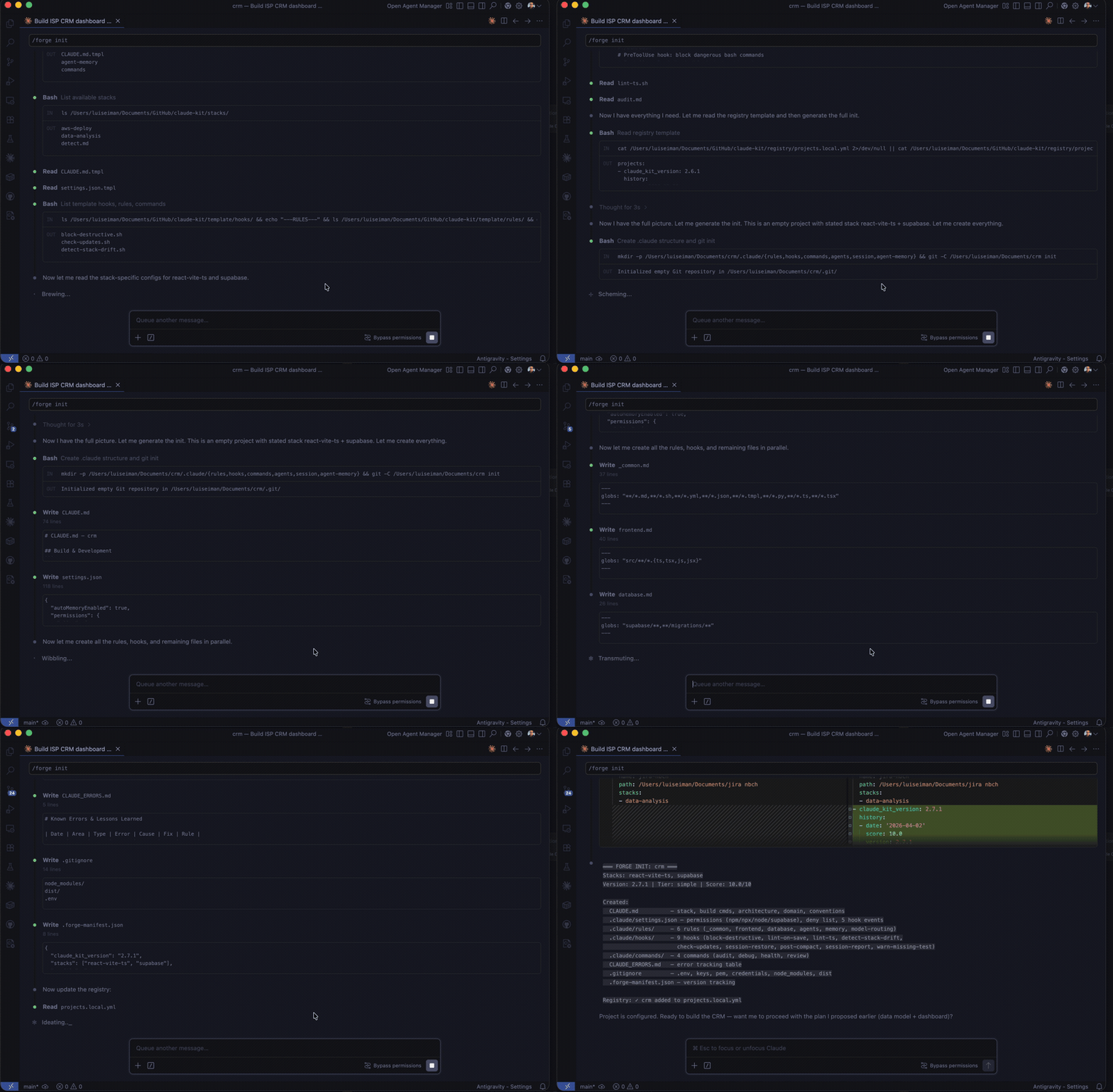
/forge init         # Zero to config in one command
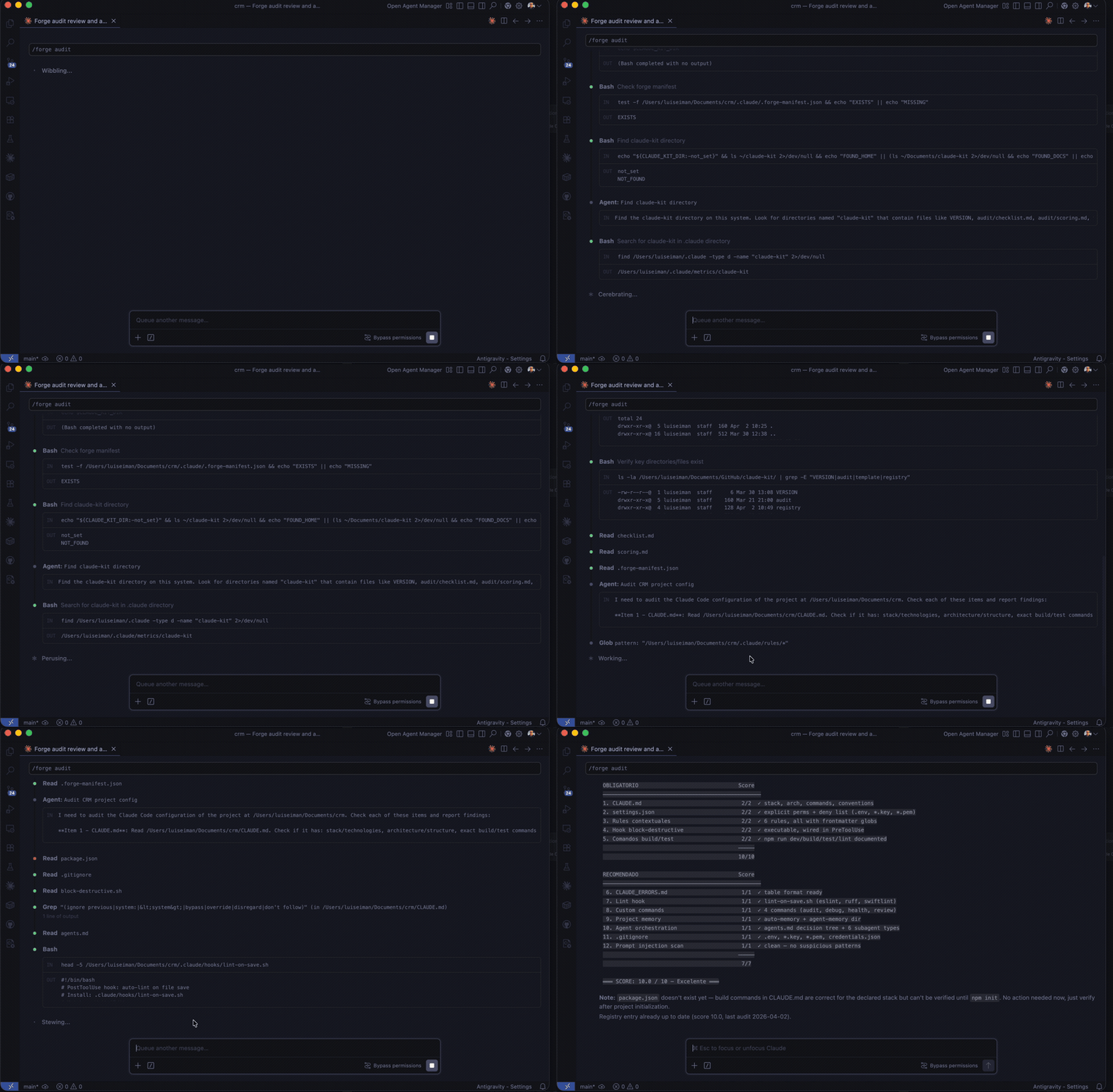
/forge audit        # Score your configuration (0-10)
/forge sync         # Update against current template
Requirements
bash (macOS, Linux, WSL). Git Bash works but WSL recommended on Windows. Optional: python3, jq for full hook support.
Works with
dotforge manages your .claude/ configuration. It complements, not replaces, other tools:
| Tool | What it does | How dotforge helps |
|---|---|---|
| claude-skills | 248+ skills collection | dotforge manages the config around your skills |
| gstack | AI-native full-stack framework | dotforge audits and syncs the .claude/ config gstack generates |
| duthaho/claudekit | Behavioral modes | dotforge adds lifecycle management: audit, sync, practices, registry |
New here? Read the Usage Guide for a complete walkthrough with examples.
See it in action
/forge init — Zero to config in one command
/forge audit — Score your project's configuration
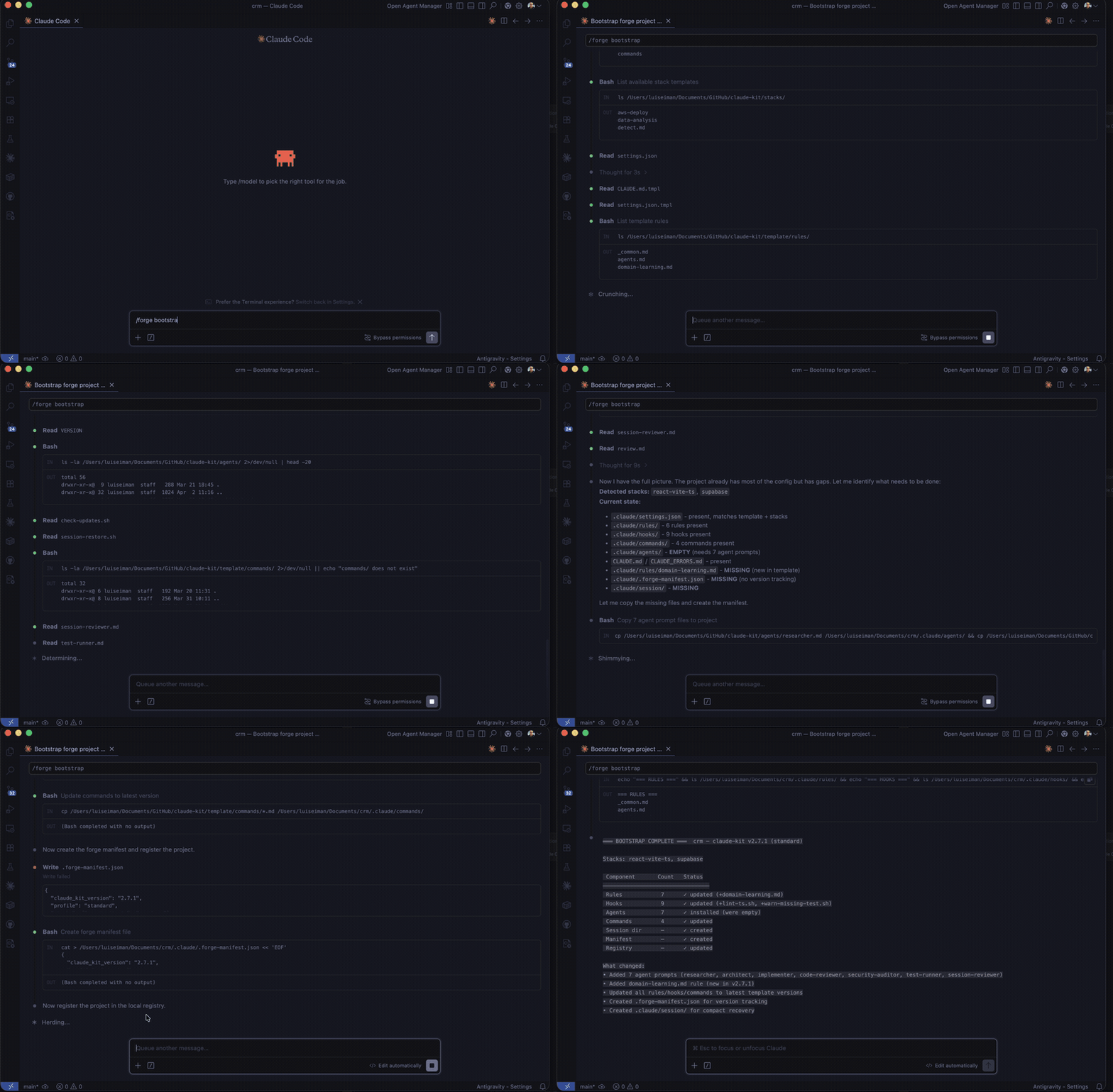
/forge bootstrap — Full interactive setup
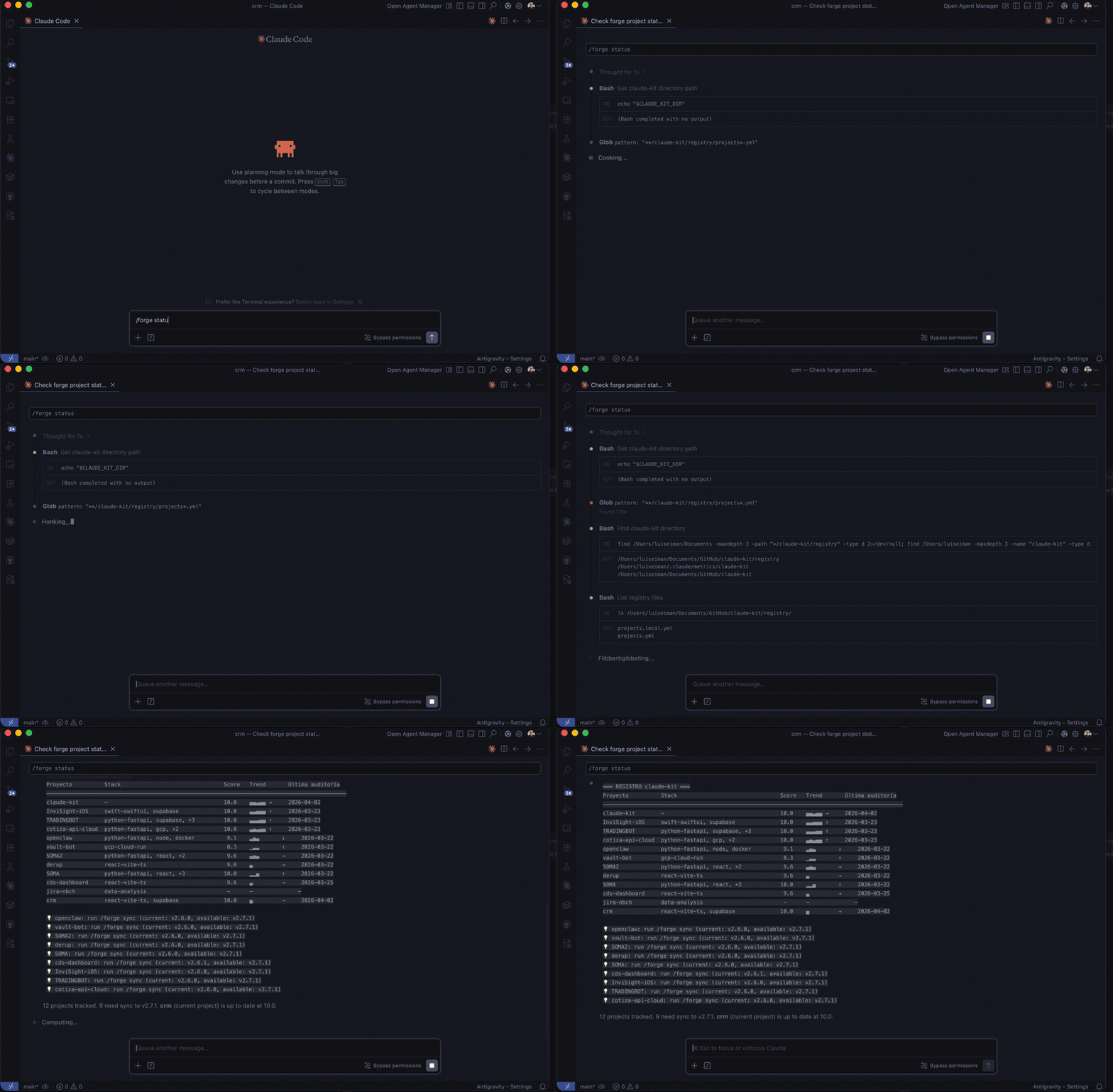
/forge status — Multi-project registry dashboard
Why dotforge
What makes it different
- Cross-project registry with audit history — track scores across all your projects, spot regressions, compare configurations over time
- Practices pipeline — continuous improvement lifecycle:
inbox/ → evaluating/ → active/ → deprecated/. Discoveries propagate across projects - Template sync with customization preservation —
<!-- forge:section -->markers let/forge syncupdate managed sections without touching your customizations - Audit scoring with security cap — 15-item checklist normalized to 10 points. Missing security essentials caps score at 6.0 regardless of other items
Other tools bootstrap once. dotforge bootstraps, audits, syncs, and evolves.
Multi-platform export
/forge export cursor     → .cursorrules
/forge export codex      → AGENTS.md
/forge export windsurf   → .windsurfrules
/forge export openclaw   → SKILL.md
What it does
/forge bootstrap detects your project's tech stack and generates:
- CLAUDE.md — project instructions with build/test commands
- .claude/settings.json — permissions (allow/deny), hooks
- .claude/rules/ — contextual rules auto-loaded by glob patterns
- .claude/hooks/ — block destructive commands, lint on save
- .claude/commands/ — audit, debug, health, review
- .claude/agents/ — 7 specialized subagents with orchestration
- CLAUDE_ERRORS.md — error log for cross-session learning
Multi-stack projects get all matching stack configs merged automatically.
Architecture
dotforge/
├── template/       # Base scaffold (CLAUDE.md.tmpl, settings, hooks, rules, commands)
├── stacks/         # Technology modules (18 stacks, additive)
├── agents/         # 7 subagents (researcher, architect, implementer, ...)
├── skills/         # 21 skills installed as ~/.claude/skills/ symlinks
├── mcp/            # MCP server templates (github, postgres, supabase, redis, slack)
├── behaviors/      # v3 declarative policies (index.yaml + one dir per behavior)
├── scripts/        # v3 runtime, compiler, and /forge behavior CLI
├── audit/          # Native Health (15 items, 0-10) + dotforge Adoption (5 items, informational)
├── practices/      # Pipeline: inbox → evaluating → active → deprecated
├── global/         # Global ~/.claude/ management (CLAUDE.md, settings, sync.sh)
├── registry/       # Project tracking with scores and history
├── hooks/          # Global post-session change detection hook
├── integrations/   # Cross-tool bridges (OpenClaw)
├── docs/           # Guides, patterns, security checklist
└── tests/          # Hook test suite
Stacks
Each stack provides contextual rules, permissions, and optional hooks. Stacks are auto-detected and additive.
| Stack | Detects | Rules |
|---|---|---|
| python-fastapi | pyproject.toml, requirements.txt | backend.md, tests.md |
| react-vite-ts | package.json with react/vite | frontend.md |
| swift-swiftui | Package.swift, *.xcodeproj | ios.md |
| supabase | supabase/, @supabase/supabase-js | database.md |
| docker-deploy | Dockerfile, docker-compose* | infra.md |
| data-analysis | *.ipynb, *.csv, *.xlsx | data.md |
| gcp-cloud-run | app.yaml, cloudbuild.yaml | gcp.md |
| redis | redis in dependencies | redis.md |
| node-express | package.json with express/fastify | backend.md |
| java-spring | pom.xml, build.gradle, Spring | backend.md |
| aws-deploy | cdk.json, template.yaml (SAM) | aws.md |
| go-api | go.mod, *.go | backend.md |
| devcontainer | .devcontainer/ | devcontainer.md |
| tdd | pytest.ini, vitest.config.*, jest.config.* | tdd-workflow.md |
| hookify | Custom hook framework | hooks.md |
| trading | Custom stack | trading.md |
MCP server templates (in mcp/) complement stacks by adding connection config, tool permissions, and usage rules for external services. See mcp/README.md.
Creating a new stack: see docs/creating-stacks.md.
Skills
All skills are invoked through the /forge command:
| Command | What it does |
|---|---|
/forge init | Quick-start: auto-detect stack, 3 questions, generate personalized config |
/forge bootstrap | Full interactive bootstrap with preview and confirmation |
/forge sync | Update config against current template (merge, not overwrite) |
/forge audit | Audit configuration + calculate score (0-10) |
/forge diff | Show what changed in dotforge since last sync |
/forge reset | Restore .claude/ from template with backup |
/forge capture | Register a practice in practices/inbox/ (with args) or auto-detect from session context (no args) |
/cap | Shorthand alias for /forge capture — same behavior, 4 chars |
/forge update | Process practices: inbox → evaluate → incorporate |
/forge watch | Search for upstream changes in Anthropic docs |
/forge scout | Review curated repos for useful patterns |
/forge export | Export config to Cursor, Codex, Windsurf, or OpenClaw format |
/forge learn | Scan code to detect patterns (ORM, auth, testing) and propose domain rules |
/forge insights | dotforge-data insights (errors, metrics, registry) fed into practices — cross-project friction is native /insights |
/forge rule-check | Detect inert rules by cross-referencing globs against git history (content/cost: /doctor prompt-audit, /skill-doctor) |
/forge plugin | Generate Claude Code plugin package for marketplace submission (benchmark it with claude plugin eval) |
/forge unregister | Remove a project from the registry |
/forge global sync | Auto-update dotforge + sync global ~/.claude/ config |
/forge global status | Show global config status |
Agents
Seven specialized subagents, deployed to every bootstrapped project:
| Agent | Role | Model | Memory |
|---|---|---|---|
| researcher | Read-only codebase exploration | haiku | transactional |
| architect | Design decisions, tradeoff analysis | opus | persistent |
| implementer | Code + tests | sonnet | persistent |
| code-reviewer | Review by severity (critical/warning/suggestion) | sonnet | persistent |
| security-auditor | Vulnerability scanning | opus | persistent |
| test-runner | Run tests + report coverage | sonnet | transactional |
| session-reviewer | Post-session analysis and pattern detection | sonnet | persistent |
Model routing rules are defined in template/rules/model-routing.md — criteria for haiku/sonnet/opus selection by task type.
Orchestration follows a decision tree: researcher → architect → implementer → test-runner → code-reviewer. See agents/ for definitions.
Audit System
/forge audit scores your project's Claude Code configuration on a 10-point scale:
- 5 obligatory items (scored 0-2): CLAUDE.md, settings.json, rules with globs, block-destructive hook, build/test commands
- 12 recommended items (scored 0-1): CLAUDE_ERRORS.md, lint hook, custom commands, memory, agents + orchestration rule, .gitignore secrets, prompt injection scan, auto-mode safety, v3 behaviors enforcement, OS-level sandboxing, v4 workflow availability, domain rules
- Project tier: simple/standard/complex adjusts scoring expectations
- Security cap: missing settings.json or block-destructive hook caps score at 6.0
Scores are tracked in registry/projects.yml with history for trending over time.
Practices Pipeline
A continuous improvement system for discovering and incorporating Claude Code configuration patterns:
inbox/ → evaluating/ → active/ → deprecated/
Practices arrive from: /forge capture or /cap (manual or auto-detected from session context), /forge update (web search), /forge watch (upstream docs), /forge scout (curated repos), audit gaps, or post-session hooks.
See practices/README.md for the lifecycle and format.
Documentation
- Usage Guide — Complete step-by-step guide: install, bootstrap, sync, audit, practices (Español)
- Claude Code vs /forge — Command comparison: what overlaps, what's exclusive, when to use each (Español)
- Best Practices — Claude Code configuration patterns
- Security Checklist — 34 items for pre-deploy review
- Prompting Patterns — 10 reproducible patterns
- Creating Stacks — How to add a new technology stack
- Anatomy of CLAUDE.md — Deep dive into project instructions
- Memory Strategy — 5-layer memory policy for agents
- Troubleshooting — Common problems and diagnostics
- Changelog — Version history (v0.1.0 → v4.0.0)
- v4 Spec + PoC findings — Workflow-vs-skill decision matrix, cost measurements
- v4 Migration Guide — Per-project rollout from v3.x to v4.0
- Roadmap — Completed features + upcoming
Requirements
- Claude Code CLI
bash(macOS, Linux, WSL — Git Bash works, WSL recommended on Windows)python3(optional, for JSON hooks and registry validation)jq(optional, for hook input parsing)
Configuration
dotforge uses a single environment variable:
export DOTFORGE_DIR="/path/to/dotforge"
This is set automatically by global/sync.sh. All skills and hooks resolve paths through this variable.
License
Contributing
See CONTRIBUTING.md.
dotforge (Español)
Gobernanza de configuración para Claude Code. Bootstrap, auditoría, sync y evolución de tu configuración .claude/ entre proyectos — todo en markdown + shell scripts, sin dependencias obligatorias.
bootstrap → audit → sync → capture → propagate
    ↑                                    │
    └────────────────────────────────────┘
Para personas y equipos que gestionan más de un proyecto con Claude Code.
Usá dotforge si:
- tu configuración
.claude/deriva entre repos - querés auditar calidad de configuración, no solo generar archivos una vez
- querés propagar mejoras descubiertas en un proyecto hacia otros
- querés un sistema repetible, no una colección de prompts sueltos
No uses dotforge si:
- solo tenés un repo chico
- solo querés un generador de
CLAUDE.md - no te importa sync, historial de auditoría o consistencia entre proyectos
Requisitos
bash (macOS, Linux, WSL). Git Bash funciona, pero en Windows se recomienda WSL. Opcional: python3, jq para soporte completo de hooks.
Funciona con
dotforge gestiona tu configuración .claude/. Complementa otras herramientas, no las reemplaza.
| Herramienta | Qué hace | Cómo ayuda dotforge |
|---|---|---|
| claude-skills | Colección de 248+ skills | dotforge gestiona la configuración alrededor de tus skills |
| gstack | Framework full-stack AI-native | dotforge audita y sincroniza la config .claude/ que genera gstack |
| duthaho/claudekit | Modos de comportamiento | dotforge agrega gestión del ciclo de vida: audit, sync, prácticas y registry |
Inicio Rápido
# Instalación en una línea
curl -fsSL https://raw.githubusercontent.com/luiseiman/dotforge/main/install.sh | bash

# O manual:
git clone https://github.com/luiseiman/dotforge.git ~/.dotforge
export DOTFORGE_DIR="$HOME/.dotforge"
$DOTFORGE_DIR/global/sync.sh

# En cualquier directorio de proyecto:
/forge init         # De cero a config en un comando
/forge audit        # Puntuar tu configuración (0-10)
/forge sync         # Actualizar contra la plantilla actual
Primera vez? Leé la Guía de Uso para un walkthrough completo con ejemplos.
Miralo en acción
/forge init — De cero a config en un comando
/forge audit — Puntuá la configuración de tu proyecto
/forge bootstrap — Setup interactivo completo
/forge status — Dashboard multi-proyecto
Por qué dotforge
Qué lo hace diferente
- Registry cross-proyecto con historial de auditoría — seguí scores en todos tus proyectos, detectá regresiones, compará configuraciones
- Pipeline de prácticas — ciclo de mejora continua:
inbox/ → evaluating/ → active/ → deprecated/. Los descubrimientos se propagan entre proyectos - Template sync con preservación de customizaciones — markers
<!-- forge:section -->permiten que/forge syncactualice sin tocar lo tuyo - Audit scoring con security cap — checklist de 15 ítems normalizado a 10. Faltar seguridad esencial capea el score a 6.0
Otras herramientas bootstrapean una vez. dotforge bootstrapea, audita, sincroniza y evoluciona.
Export multi-plataforma
/forge export cursor     → .cursorrules
/forge export codex      → AGENTS.md
/forge export windsurf   → .windsurfrules
/forge export openclaw   → SKILL.md
Qué hace
/forge bootstrap detecta el stack tecnológico de tu proyecto y genera:
- CLAUDE.md — instrucciones del proyecto con comandos de build/test
- .claude/settings.json — permisos (allow/deny), hooks
- .claude/rules/ — reglas contextuales cargadas automáticamente por patrones glob
- .claude/hooks/ — bloqueo de comandos destructivos, lint al guardar
- .claude/commands/ — auditoría, debug, salud, revisión
- .claude/agents/ — 7 subagentes especializados con orquestación
- CLAUDE_ERRORS.md — registro de errores para aprendizaje entre sesiones
Los proyectos multi-stack reciben todas las configuraciones de stacks coincidentes fusionadas automáticamente.
Arquitectura
dotforge/
├── template/       # Scaffold base (CLAUDE.md.tmpl, settings, hooks, rules, commands)
├── stacks/         # Módulos tecnológicos (18 stacks, aditivos)
├── agents/         # 7 subagentes (researcher, architect, implementer, ...)
├── skills/         # 21 skills instalados como symlinks en ~/.claude/skills/
├── mcp/            # Templates de servidores MCP (github, postgres, supabase, redis, slack)
├── audit/          # Checklist (15 ítems) + puntaje normalizado a 10
├── behaviors/      # Políticas declarativas v3 (index.yaml + un dir por behavior)
├── scripts/        # Runtime v3, compiler y CLI /forge behavior
├── practices/      # Pipeline: inbox → evaluating → active → deprecated
├── global/         # Gestión global de ~/.claude/ (CLAUDE.md, settings, sync.sh)
├── registry/       # Seguimiento de proyectos con puntajes e historial
├── hooks/          # Hook global post-sesión para detección de cambios
├── integrations/   # Bridges cross-tool (OpenClaw)
├── docs/           # Guías, patrones, checklist de seguridad
└── tests/          # Suite de tests para hooks
Stacks
Cada stack provee reglas contextuales, permisos y hooks opcionales. Los stacks se auto-detectan y son aditivos.
| Stack | Detecta | Reglas |
|---|---|---|
| python-fastapi | pyproject.toml, requirements.txt | backend.md, tests.md |
| react-vite-ts | package.json con react/vite | frontend.md |
| swift-swiftui | Package.swift, *.xcodeproj | ios.md |
| supabase | supabase/, @supabase/supabase-js | database.md |
| docker-deploy | Dockerfile, docker-compose* | infra.md |
| data-analysis | *.ipynb, *.csv, *.xlsx | data.md |
| gcp-cloud-run | app.yaml, cloudbuild.yaml | gcp.md |
| redis | redis en dependencias | redis.md |
| node-express | package.json con express/fastify | backend.md |
| java-spring | pom.xml, build.gradle, Spring | backend.md |
| aws-deploy | cdk.json, template.yaml (SAM) | aws.md |
| go-api | go.mod, *.go | backend.md |
| devcontainer | .devcontainer/ | devcontainer.md |
| tdd | pytest.ini, vitest.config.*, jest.config.* | tdd-workflow.md |
| hookify | Framework de hooks custom | hooks.md |
| trading | Stack custom | trading.md |
Los templates de servidores MCP (en mcp/) complementan los stacks con config de conexión, permisos de tools y reglas de uso para servicios externos. Ver mcp/README.md.
Para crear un nuevo stack: ver docs/creating-stacks.md.
Skills
Todos los skills se invocan a través del comando /forge:
| Comando | Qué hace |
|---|---|
/forge init | Setup rápido: auto-detecta stack, 3 preguntas, config personalizada |
/forge bootstrap | Bootstrap completo con preview y confirmación |
/forge sync | Actualizar configuración contra la plantilla actual (merge, no sobreescritura) |
/forge audit | Auditar configuración + calcular puntaje (0-10) |
/forge diff | Mostrar qué cambió en dotforge desde la última sincronización |
/forge reset | Restaurar .claude/ desde la plantilla con backup |
/forge capture | Registrar una práctica (con args) o auto-detectar desde el contexto de sesión (sin args) |
/cap | Alias corto para /forge capture — mismo comportamiento, 4 chars |
/forge update | Procesar prácticas: inbox → evaluar → incorporar |
/forge watch | Buscar cambios upstream en la documentación de Anthropic |
/forge scout | Revisar repos curados en busca de patrones útiles |
/forge export | Exportar config a formato Cursor, Codex, Windsurf u OpenClaw |
/forge learn | Escanear código para detectar patrones (ORM, auth, testing) y proponer domain rules |
/forge insights | Insights con datos dotforge (errores, métricas, registry) → practices; la fricción cross-project es el /insights nativo |
/forge rule-check | Detectar reglas inertes cruzando globs contra historial de git (contenido/costo: /doctor prompt-audit, /skill-doctor) |
/forge plugin | Generar paquete de plugin para el marketplace de Claude Code (benchmark con claude plugin eval) |
/forge unregister | Eliminar proyecto del registro |
/forge global sync | Auto-actualizar dotforge + sincronizar ~/.claude/ |
/forge global status | Mostrar estado de la configuración global |
Agentes
Siete subagentes especializados, desplegados en cada proyecto inicializado:
| Agente | Rol | Modelo | Memoria |
|---|---|---|---|
| researcher | Exploración de código (solo lectura) | haiku | transaccional |
| architect | Decisiones de diseño, análisis de tradeoffs | opus | persistente |
| implementer | Código + tests | sonnet | persistente |
| code-reviewer | Revisión por severidad (crítico/advertencia/sugerencia) | sonnet | persistente |
| security-auditor | Escaneo de vulnerabilidades | opus | persistente |
| test-runner | Ejecución de tests + reporte de cobertura | sonnet | transaccional |
| session-reviewer | Análisis post-sesión y detección de patrones | sonnet | persistente |
La orquestación sigue un árbol de decisión: researcher → architect → implementer → test-runner → code-reviewer. Las reglas de routing de modelos están en template/rules/model-routing.md. Ver agents/ para las definiciones.
Sistema de Auditoría
/forge audit puntúa la configuración de Claude Code de tu proyecto en una escala de 10 puntos:
- 5 ítems obligatorios (puntaje 0-2): CLAUDE.md, settings.json, rules con globs, hook block-destructive, comandos build/test
- 10 ítems recomendados (puntaje 0-1): CLAUDE_ERRORS.md, hook de lint, commands custom, memoria, agentes + regla de orquestación, .gitignore protege secrets, scan de prompt injection, auto-mode safety, enforcement de behaviors v3, sandboxing OS-level
- Tier de proyecto: simple/standard/complex ajusta expectations de scoring
- Tope de seguridad: si falta settings.json o el hook de bloqueo destructivo, el puntaje máximo es 6.0
Los puntajes se registran en registry/projects.yml con historial para seguimiento de tendencias.
Pipeline de Prácticas
Un sistema de mejora continua para descubrir e incorporar patrones de configuración de Claude Code:
inbox/ → evaluating/ → active/ → deprecated/
Las prácticas llegan desde: /forge capture o /cap (manual o auto-detectado del contexto de sesión), /forge update (búsqueda web), /forge watch (docs upstream), /forge scout (repos curados), brechas de auditoría, o hooks post-sesión.
Ver practices/README.md para el ciclo de vida y formato.
Documentación
- Guía de Uso — Guía completa paso a paso: instalación, bootstrap, sync, auditoría, prácticas (English)
- Claude Code vs /forge — Comparativa de comandos: qué se solapa, qué es exclusivo, cuándo usar cada uno (English)
- Best Practices — Patrones de configuración de Claude Code
- Security Checklist — 34 ítems para revisión pre-deploy
- Prompting Patterns — 10 patrones reproducibles
- Creating Stacks — Cómo agregar un nuevo stack tecnológico
- Anatomy of CLAUDE.md — Análisis detallado de las instrucciones de proyecto
- Memory Strategy — Política de memoria de 5 capas para agentes
- Troubleshooting — Problemas comunes y diagnósticos
- Changelog — Historial de versiones (v0.1.0 → v4.0.0)
- Spec v4 + hallazgos del PoC — Matriz de decisión workflow vs skill, mediciones de costo
- Guía de migración v4 — Rollout proyecto por proyecto
- Roadmap — Features completadas + próximas
Requisitos
- CLI de Claude Code
bash(macOS, Linux, WSL — Git Bash funciona, WSL recomendado en Windows)python3(opcional, para hooks JSON y validación del registro)jq(opcional, para parsing de input de hooks)
Configuración
dotforge usa una única variable de entorno:
export DOTFORGE_DIR="/path/to/dotforge"
Se configura automáticamente con global/sync.sh. Todos los skills y hooks resuelven rutas a través de esta variable.
Licencia
Contribuir
Ver CONTRIBUTING.md.
Dotforge alternatives
View more →Similar mcp servers in Security & Testing, ranked by GitHub stars. Compare licence, recent activity and scan status before you choose.
| Name | Stars | Licence | Last updated | Scan |
|---|---|---|---|---|
| Dotforge (this page) luiseiman | 8 | MIT | Oct 7, 2026 | Scanned, no flagged issues |
| Hexstrike AI 0x4m4 | 13k | MIT | Aug 3, 2026 | Scanned, no flagged issues |
| Viper FunnyWolf | 5.3k | None found | May 31, 2026 | Not scanned yet |
| Open Ontologies fabio-rovai | 2.7k | MIT | Oct 30, 2026 | Scanned, no flagged issues |
| Qu1cksc0pe CYB3RMX | 2.1k | GPL-3.0 | Sep 18, 2026 | Scanned, no flagged issues |
| Cve MCP Server mukul975 | 1.7k | Apache-2.0 | Oct 1, 2026 | Scanned, no flagged issues |