MCP Server by kubeflow
 by kubeflow
MCP Server for AI-Assisted Development with Kubeflow Tools
MCP Server is an open-source mcp server by kubeflow, written mainly in Python, with 56 GitHub stars and the Apache-2.0 license. Its code was last updated Oct 26, 2026. The latest PyPI release is kubeflow-mcp 0.1.1, published Aug 11, 2026, with 26 downloads last week.
Kubeflow MCP Server
<!-- mcp-name: io.github.kubeflow/mcp-server -->



Proposal: KEP-936 · ROADMAP · SECURITY · CONTRIBUTING
Overview
The Kubeflow MCP Server exposes Kubeflow Training operations as Model Context Protocol tools, enabling AI agents (Claude, Cursor, Claude Code, or any custom agents etc.) to plan, submit, monitor, and manage training jobs through natural language — without users needing to learn Kubernetes or the Kubeflow SDK directly.
Benefits
- Agent-Native: Tools auto-discovered via MCP — no manual API wiring
- Guided Workflow: Phase ordering with next-step hints (Plan → Discover → Train → Monitor)
- Preview-Before-Submit: Every mutating operation requires explicit confirmation
- Security-First: Persona gating, namespace enforcement, input validation, bearer/JWT auth
- Multi-Platform: Auto-detects OpenShift, EKS, GKE with platform-specific guidance
- Token-Efficient: Progressive/semantic modes compress 23 tools into 2-3 meta-tools
- Extensible: Plugin architecture for additional Kubeflow clients (trainer, spark, pipelines; TODO: optimizer, hub)
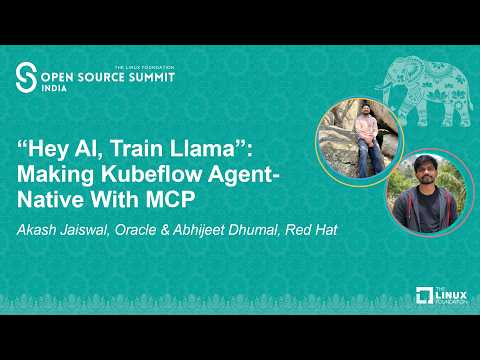
Demo
Get Started
New here? See the Quickstart & Troubleshooting guide for a step-by-step path from installation to a working MCP client.
Install from PyPI
pip install kubeflow-mcp
Install from source (development)
git clone https://github.com/kubeflow/mcp-server.git
cd mcp-server
make install-dev
Prerequisites
Before starting the Kubeflow MCP Server, make sure the following requirements are available:
- Python 3.10, 3.11, or 3.12
- A running Kubernetes cluster
kubectlinstalled and available inPATH- A kubeconfig configured for the target cluster
- Kubeflow Trainer installed in the cluster
- Kubeflow Trainer CRDs and at least one
ClusterTrainingRuntime - Kubernetes permissions for the namespace you train in, plus cluster-scoped read access for planning and runtime discovery (see RBAC Configuration)
Verify the connection and your permissions in the target namespace. Each
can-i command should print yes:
kubectl config current-context
kubectl auth can-i create trainjobs.trainer.kubeflow.org -n <namespace>
kubectl auth can-i list pods -n <namespace>
kubectl auth can-i get pods --subresource=log -n <namespace>
The checks below need cluster-scoped read access, so they can return
Forbidden for a namespace-scoped user even when Kubeflow Trainer is installed
correctly. Without that access, the tools that read these resources
(get_cluster_resources, check_compatibility, list_runtimes) fail; tools
that work on jobs in your namespace are unaffected.
kubectl get nodes
kubectl get crd trainjobs.trainer.kubeflow.org
kubectl get clustertrainingruntimes
Run the server
kubeflow-mcp serve
Run with Docker
Pre-built multi-arch images are published to GHCR on every release:
docker run --rm -p 8000:8000 \
  -e KUBEFLOW_MCP_AUTH_TOKEN=my-secret-token \
  ghcr.io/kubeflow/mcp-server:latest
The server listens on http://localhost:8000/mcp.
Container and Kubernetes probes are available without MCP authentication:
GET /health  # liveness: the server process is accepting HTTP requests
GET /ready   # readiness: configured clients imported and packaged resources loaded
/ready returns 200 only when both clients_ready and resources_ready are true. It does
not contact Kubernetes or other APIs, so it is not a live dependency check. A missing
packaged resource Markdown file keeps /ready at 503 even though /health and registered
tools remain available; check the server logs and package contents rather than cluster
dependencies.
Environment variables
| Variable | Default | Description |
|---|---|---|
MCP_TRANSPORT | stdio | Transport protocol (http, stdio; sse is deprecated) |
KUBEFLOW_MCP_AUTH_TOKEN | (none) | Bearer token for HTTP auth |
KUBEFLOW_MCP_JWKS_URI | (none) | JWKS endpoint for JWT verification (production) |
KUBEFLOW_MCP_JWT_ISSUER | (none) | Expected JWT issuer |
KUBEFLOW_MCP_JWT_AUDIENCE | (none) | Expected JWT audience |
KUBEFLOW_MCP_CLIENTS | trainer | Comma-separated client modules to load |
KUBEFLOW_MCP_PERSONA | readonly | Tool persona (readonly, data-scientist, ml-engineer, platform-admin, or a custom persona from the policy file) |
KUBEFLOW_MCP_INSTRUCTION_TIER | full | Instruction verbosity (full, compact, minimal) |
KUBEFLOW_MCP_ALLOWED_HOSTS | (loopback) | Comma-separated Host header allowlist for DNS rebinding protection; :* port wildcard supported (e.g. mcp.example.com,mcp.example.com:*) |
KUBEFLOW_MCP_ALLOWED_ORIGINS | (loopback) | Comma-separated Origin header allowlist; :* port wildcard supported (e.g. https://mcp.example.com) |
KUBEFLOW_MCP_DNS_REBINDING_PROTECTION | true | Set false to disable Host/Origin validation (not recommended) |
LOG_FORMAT | (auto) | Log format (json, console); defaults to console in an interactive terminal and json otherwise |
LOG_LEVEL | INFO | Log level (DEBUG, INFO, WARNING, ERROR) |
MCP client config (HTTP transport)
{
  "mcpServers": {
    "kubeflow": {
      "url": "http://localhost:8000/mcp",
      "headers": { "Authorization": "Bearer my-secret-token" }
    }
  }
}
For in-cluster deployments, replace localhost:8000 with the Kubernetes Service address and mount KUBEFLOW_MCP_AUTH_TOKEN from a Secret.
Note: DNS rebinding protection allows only loopback
Host/Originheaders by default. When exposing the server through a Service or Ingress, setKUBEFLOW_MCP_ALLOWED_HOSTS(e.g.KUBEFLOW_MCP_ALLOWED_HOSTS=kubeflow-mcp.kubeflow.svc:*,mcp.example.com) or requests will be rejected with HTTP 421.
Example: Fine-tune a model via AI agent
Once connected, your AI agent can run a complete training workflow through natural language:
User: "Fine-tune gemma-2b on the alpaca dataset"

Agent calls: check_compatibility()        → ✅ K8s 1.29, Trainer CRD installed
Agent calls: get_cluster_resources()      → 4x A100 GPUs available
Agent calls: estimate_resources("google/gemma-2b") → needs ~16GB GPU, 1x A100
Agent calls: list_runtimes()              → torchtune-llama, torchtune-gemma, ...
Agent calls: fine_tune(                   → preview config (confirmed=False)
    model="hf://google/gemma-2b",
    dataset="hf://tatsu-lab/alpaca",
    runtime="torchtune-gemma-2b"
)
Agent calls: fine_tune(..., confirmed=True) → TrainJob "train-gemma-abc" created
Agent calls: get_training_logs("train-gemma-abc") → training progress...
All mutating tools require confirmed=True and return a preview before making changes.
MCP Client Config
<details> <summary>Cursor</summary>Add to .cursor/mcp.json (or use the .mcp.json at the repo root for local dev):
{
  "mcpServers": {
    "kubeflow": {
      "command": "uv",
      "args": ["run", "kubeflow-mcp", "serve"]
    }
  }
}
claude mcp add kubeflow -- kubeflow-mcp serve
Tools
23 tools organized by workflow phase:
| Phase | Tools | Description |
|---|---|---|
| Planning | pre_flight, check_compatibility, get_cluster_resources, estimate_resources | Environment validation and resource estimation |
| Discovery | list_training_jobs, get_training_job, list_runtimes, get_runtime | Browse jobs and available runtimes |
| Training | fine_tune, run_custom_training, run_container_training | Submit LoRA/QLoRA fine-tuning, custom scripts, or container jobs |
| Monitoring | get_training_logs, get_training_events, wait_for_training | Track progress, debug failures |
| Lifecycle | delete_training_job, update_training_job | Manage existing jobs (ownership-guarded) |
| Platform | inspect_crd, inspect_controller, patch_runtime, create_runtime, delete_runtime | Cluster inspection and runtime management |
| Health | health_check, get_server_logs | Server diagnostics |
Spark tools
Enabled with --clients trainer,spark (requires the kubeflow[spark] extra):
| Phase | Tools | Description |
|---|---|---|
| Discovery | list_spark_sessions, get_spark_session | Browse SparkConnect sessions |
| Sessions | create_spark_session, delete_spark_session | Provision and tear down SparkConnect sessions (ownership-guarded) |
| Monitoring | get_spark_session_logs | Read driver logs |
Sessions created through MCP are labelled kubeflow-mcp/managed-by=mcp. Non-admin
personas may only delete sessions carrying that label; use the platform-admin
persona to manage sessions created outside MCP.
Creation supports CPU/memory resources and an optional service_account_name for
the driver. The selected account must already exist and have namespace-scoped
Spark workload RBAC; see spark://guides/session-patterns. GPU resource keys are
rejected because SDK 0.5.0's SparkConnect builder does not preserve them.
SDK 0.5.0 batch jobs (FileJob/FuncJob) are separate MCP follow-up scope in
#331; this session module is
only part of #5.
Pipelines client
Enable with --clients trainer,pipelines. Wraps kubeflow.pipelines.PipelinesClient.
| Phase | Tools | Description |
|---|---|---|
| Discovery | list_pipelines, get_pipeline | Browse registered pipelines and their versions |
| Monitoring | list_pipeline_runs, get_pipeline_run, get_pipeline_logs | Follow runs, read task pod logs |
| Runs | create_pipeline_run, stop_pipeline_run, retry_pipeline_run | Start, stop or retry runs (preview first) |
Requires kfp on the server host. Upstream kfp 2.x pins kubernetes<31
(kubeflow/pipelines#13390), which
cannot coexist with the kubernetes>=35 client this repository's own development and
test environments resolve, so kfp is not installed by default and not part of the
all extra. Use a pip environment for the server host and install the Kubeflow SDK's
pipelines extra in the same resolution as the MCP server:
pip install kubeflow-mcp 'kubeflow[pipelines]'
# or from a checkout of this repository:
pip install . 'kubeflow[pipelines]'
pip then resolves the kubernetes python client to a kfp-compatible release (<31);
the Kubeflow SDK itself accepts any >=27.2,<36. If pip prints a warning that a
kubeflow release "does not provide the extra 'pipelines'", the resolution picked an
older kubeflow-mcp (the 0.1.x releases pin kubeflow==0.4.0, which has no
pipelines extra) and kfp was skipped: upgrade kubeflow-mcp to >=0.2.x and
re-install.
Validate the real SDK contracts in the environment where kfp is installed,
from a checkout of this repository:
pip install pytest
python -m pytest kubeflow_mcp/pipelines/api/sdk_contracts_test.py
Set KUBEFLOW_MCP_PIPELINES_URL, KUBEFLOW_MCP_PIPELINES_TOKEN or
KUBEFLOW_MCP_PIPELINES_NAMESPACE when the defaults do not fit. Only registered pipelines
can be run, by name. Stop and retry need the ml-engineer persona because KFP runs carry
no MCP ownership label.
Requirements
| MCP Server | Kubeflow Trainer | Kubeflow SDK | Python | Kubernetes |
|---|---|---|---|---|
| 0.2.x (upcoming) | >= 2.3.0, < 2.4.0 | >= 0.5.0, < 0.6.0 | 3.10 - 3.12 | >= 1.27 |
| 0.1.x | == 2.2.1 | == 0.4.1 | 3.10 - 3.12 | >= 1.27 |
CLI Reference
kubeflow-mcp serve
# Modules: trainer, spark, pipelines, optimizer (stub), hub (stub)
# Persona: readonly | data-scientist | ml-engineer | platform-admin
# Mode: full | progressive | semantic
# Instruction tier: full | compact | minimal
# Transport: stdio | http | sse (deprecated)
# Auth token: bearer token for HTTP auth (dev/staging)
# OTel endpoint: optional OTLP HTTP endpoint for tracing
# Log level: DEBUG | INFO | WARNING | ERROR
# Log format: console | json (auto-detected if omitted)
# No banner: suppress the FastMCP startup banner
kubeflow-mcp serve \
  --clients trainer,spark \
  --persona ml-engineer \
  --mode full \
  --instruction-tier full \
  --transport stdio \
  --auth-token SECRET \
  --otel-endpoint URL \
  --log-level INFO \
  --log-format console \
  --no-banner
| Flag | Values |
|---|---|
--clients | trainer, spark, optimizer (stub), hub (stub) |
--persona | readonly | data-scientist | ml-engineer | platform-admin |
--mode | full | progressive | semantic |
--instruction-tier | full | compact | minimal |
--transport | stdio | http | sse |
--auth-token | bearer token for HTTP auth (dev/staging) |
--otel-endpoint | OTLP HTTP endpoint (optional tracing) |
--log-level | DEBUG | INFO | WARNING | ERROR |
--log-format | console | json (auto-detected if omitted) |
--no-banner | suppress startup banner |
--mode progressive exposes 3 meta-tools (~85 tokens) for hierarchical discovery. --mode semantic exposes 2 meta-tools (~69 tokens) using embedding search. Both reduce token consumption significantly for agent workflows.
--persona controls which tools are exposed. Each persona includes the tools of the one above it:
| Persona | Use it for |
|---|---|
readonly (default) | Planning, browsing jobs and runtimes, reading logs and events |
data-scientist | Submitting fine-tuning and custom training, waiting for jobs, deleting MCP-created jobs |
ml-engineer | Container training, suspending/resuming jobs, inspecting CRDs and the controller |
platform-admin | All tools, including creating, patching and deleting runtimes |
A custom persona defined under personas: in ~/.kf-mcp-policy.yaml can be used the same way, from --persona, KUBEFLOW_MCP_PERSONA or the config file. An unknown persona from any of them stops serve with an error.
When using --transport http, configure auth to secure the endpoint:
# Simple API key (dev/staging)
kubeflow-mcp serve --transport http --auth-token my-secret-token

# Or via env var
export KUBEFLOW_MCP_AUTH_TOKEN=my-secret-token
kubeflow-mcp serve --transport http

# JWT verification (production)
export KUBEFLOW_MCP_JWKS_URI=https://auth.example.com/.well-known/jwks.json
export KUBEFLOW_MCP_JWT_ISSUER=https://auth.example.com
export KUBEFLOW_MCP_JWT_AUDIENCE=kubeflow-mcp
kubeflow-mcp serve --transport http
Without auth configured, the server logs a warning that the HTTP endpoint is open.
</details>Observability
OpenTelemetry tracing is optional and can be enabled without changing tool code.
- Install optional dependencies from source:
uv sync --group otel - Enable tracing with CLI flag or env var:
kubeflow-mcp serve --otel-endpoint http://localhost:4318
# or
export OTEL_EXPORTER_OTLP_ENDPOINT=http://localhost:4318
kubeflow-mcp serve
Each tool invocation emits an execute_tool <tool> span with attributes:
tool.name, tool.args_preview, tool.success, tool.duration_ms, kubeflow.persona, and correlation_id.
It is a child of the tools/call <tool> span that FastMCP creates, which continues the
caller's trace when the request _meta carries a W3C traceparent.
JSON logs and get_server_logs entries include trace_id and span_id while a span is
active, so logs can be joined to traces. A missing or malformed traceparent just starts
a new trace.
Development
make install-dev                  # setup environment
make verify                       # lint + format check
make test-python                  # run tests
make inspector                    # launch MCP Inspector (stdio)
make inspector TRANSPORT=http     # Inspector + Streamable HTTP (start server separately)
make inspector TRANSPORT=sse      # Inspector + SSE (deprecated; start server separately)
Community
- Slack: Join #kubeflow-ml-experience on CNCF Slack
- Meetings: Attend the Kubeflow SDK and ML Experience bi-weekly call
- GitHub: Issues and contributions at kubeflow/mcp-server
Documentation
- Quickstart & Troubleshooting: Install, connect a client, verify connectivity, and diagnose common failures
- CONTRIBUTING: Development workflow and PR guidelines
- ROADMAP: Project roadmap
- SECURITY: Vulnerability reporting; see ARCHITECTURE.md#security-model for threat model, RBAC, and hardening
- Client conventions: Checklist for adding client modules
- KEP-936: Design proposal
License
Apache License 2.0 — see LICENSE.
✨ Contributors
We couldn't have done it without these incredible people:
<a href="https://github.com/kubeflow/mcp-server/graphs/contributors"> <img src="https://contrib.rocks/image?repo=kubeflow/mcp-server" /> </a>MCP Server alternatives
View more →Similar mcp servers in Other, ranked by GitHub stars. Compare licence, recent activity and scan status before you choose.
| Name | Stars | Licence | Last updated | Scan |
|---|---|---|---|---|
| MCP Server (this page) kubeflow | 56 | Apache-2.0 | Oct 26, 2026 | Scanned, no flagged issues |
| Github MCP Server github | 34k | MIT | Oct 30, 2026 | Scanned, no flagged issues |
| Fastapi MCP tadata-org | 12k | MIT | Nov 24, 2025 | Scanned, no flagged issues |
| GhidraMCP LaurieWired | 12k | Apache-2.0 | Oct 10, 2026 | Scanned, no flagged issues |
| MCP Go mark3labs | 9.2k | MIT | Oct 30, 2026 | Scanned, no flagged issues |
| Git MCP idosal | 8.5k | Apache-2.0 | May 8, 2026 | Scanned, no flagged issues |